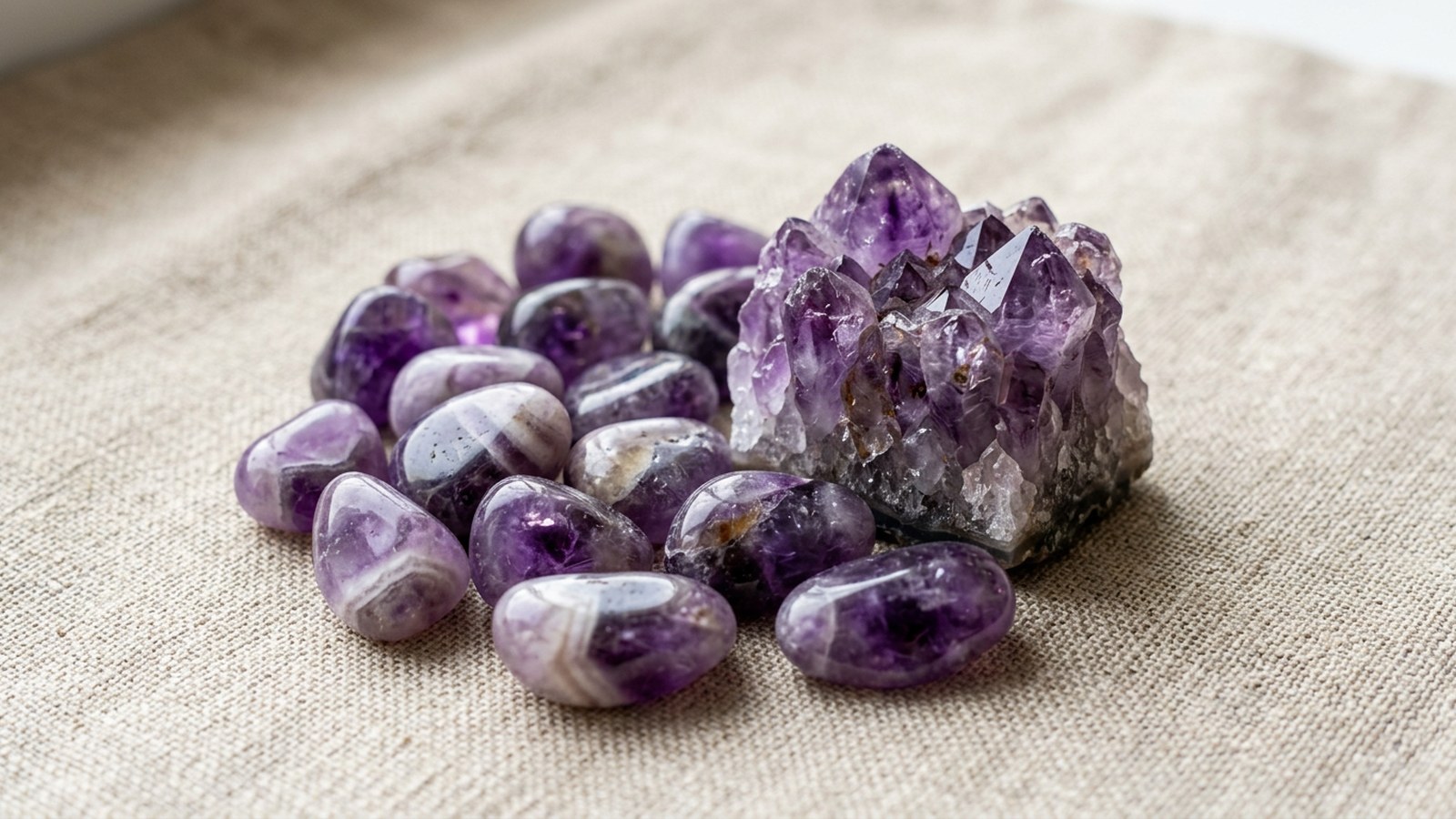
Most of the calm I have found in my own life arrived in very small pieces. A slow breath before answering an email, a minute at the window, a cool stone turning over in my palm while a kettle boils. I started keeping calming crystals within reach years ago, at first because they were beautiful, and later because I noticed that picking one up had become a signal to my body that it was allowed to slow down.
This guide gathers the stones I reach for, and the ones most often recommended, sorted by the kind of restless you might be feeling, since a racing mind at midnight and a short temper at five in the afternoon rarely want the same thing. You will also find a two minute practice, a care table that most lists leave out, and an honest word on what a stone can and cannot do.
What are calming crystals? The short answer
Calming crystals are stones people use as physical anchors to slow down, breathe and come back to the present moment when they feel tense, overstimulated or wound up. In crystal tradition the best known are amethyst, lepidolite, blue lace agate, rose quartz, howlite, aquamarine, smoky quartz, black tourmaline and selenite. Most are soft in colour (lavender, pale blue, pink, white or smoky grey), and they are usually held, carried, worn or placed beside the bed.
If you want a single answer to the question of the best crystal for calming the mind, amethyst is the stone most people start with, and lepidolite is the one I give to friends whose thoughts will not stop looping at night.
How a stone can help you calm down
I want to be clear about this at the start, because it shapes how you will use everything below. There is no published evidence that a crystal changes your nervous system by itself. What a stone does very well is give your attention somewhere to land. It has weight, temperature and texture, and when you hold it you are, for a moment, paying attention to your hand and to your breathing.
That moment matters more than it sounds. A 2023 study by Balban and colleagues at Stanford, published in Cell Reports Medicine, found that five minutes a day of slow breathing with long exhales (they called it cyclic sighing) improved mood and lowered breathing rate, and did so slightly more than the same time spent in mindfulness meditation. A calming crystal is, at its most practical, a reminder to do that kind of breathing. The traditions attached to each stone, which I share below, then give the moment a meaning and an intention, and for many people that meaning is part of what makes the habit stick.
Calming crystals by the kind of restless you feel
When your mind will not slow down: amethyst and lepidolite
Amethyst is the purple variety of quartz, coloured by traces of iron and natural irradiation, and its name comes from the Greek amethystos, "not intoxicated." The old belief that it kept the wearer clear headed has turned, in modern crystal practice, into its reputation as the stone for an overactive mind. It is linked to the third eye and crown chakras. I keep a small cluster on my bedside table and hold a tumbled piece when my thoughts start rehearsing tomorrow. At hardness 7 it is tough enough to carry every day.
Lepidolite is a lilac mica that contains lithium, and that detail has given it a large and slightly misleading reputation. The lithium is locked inside the crystal structure, your skin does not absorb it, and the stone is in no way a dose of the lithium used in psychiatric medicine. What lepidolite does offer is a soft, glittering, slightly flaky surface that feels very soothing under the thumb, and a long tradition as a stone for emotional steadiness and sleep. It suits people who ruminate. It suits people who want a pocket stone less well, because at hardness 2.5 to 3 it scratches and sheds flakes.
When your chest is tight and the words are stuck: blue lace agate and aquamarine
Blue lace agate is a banded chalcedony with fine pale blue and white lines, and much of the classic material came from Namibia. Tradition ties it to the throat chakra and to gentle, unhurried speech, which is why I reach for it before a conversation I am dreading. Its pale colour is easy to imitate, so be wary of very bright blue pieces, which are often dyed.
Aquamarine is the sea blue variety of beryl, coloured by iron, and sailors once carried it as a charm for calm water and safe passage. In crystal practice it is the stone for cooling things down: a heated exchange, a tense meeting, the tight chest before speaking in public. It is hard (7.5 to 8), so it works well as a ring or pendant you can touch without anyone noticing. If social pressure is the main source of your nerves, my guide to crystals for communication goes further into the throat stones.
When your inner voice turns harsh: rose quartz
Some restlessness is really self criticism running on repeat. Rose quartz, the pale pink quartz associated with the heart chakra, is the stone traditionally used for self compassion. I hold it with one hand over my chest for a few breaths and say one kind sentence to myself, the kind I would say to a friend. It is a gentle stone, and people who want something to steady them in a crisis often find it too soft for that job.
When you feel irritable and short tempered: howlite
Howlite is a white calcium borate with fine grey veining, first described in Nova Scotia in 1868 and named after the Canadian chemist Henry How. Crystal tradition treats it as the stone for patience and a cooler temper, and its plain, chalky look has a calming quality of its own. It is soft (about 3.5) and porous, and most of the "turquoise" you see in cheap bead bracelets is howlite dyed blue, so choose undyed white pieces for this purpose.
When you are overstimulated by noise, screens or people: smoky quartz and black tourmaline
After a crowded event or a long day of screens, my nervous system feels loud, as if every sound has been turned up a notch. For that I want something darker and heavier. Smoky quartz, coloured by natural radiation acting on traces of aluminium, and black tourmaline, the iron rich tourmaline called schorl, are both linked to the root chakra and to grounding. Holding one with both feet on the floor is my quickest way back into my body. These stones suit overstimulation very well and are less helpful for sadness, where rose quartz is kinder. My guide to grounding crystals covers this family in more depth.
When the house itself feels busy: selenite
Selenite is a clear, silky variety of gypsum, and a tower or slab of it in a shared room is a quiet visual cue that this is a place to slow down. Crystal tradition credits it with clearing the energy of a space, and it is often paired with black tourmaline by the front door, a combination I discuss in black tourmaline and selenite. Most "selenite" wands sold today are actually satin spar, a fibrous form of the same mineral, which I explain in selenite vs satin spar. Both are very soft and both are damaged by water.
A two minute calming practice with a crystal
This is the practice I use most, built on the slow exhale breathing from the study above.
- Choose the stone that matches how you feel right now, using the sections above.
- Sit or stand with both feet on the floor and hold the stone in your open palm. Notice its weight and temperature for one breath.
- Breathe in through your nose, then take a second short inhale on top of the first to fill your lungs.
- Breathe out slowly through your mouth, for longer than you breathed in, while closing your hand around the stone.
- Repeat for two minutes, or about eight to ten breaths.
- Before you put the stone down, name one small next step, out loud or in your head.
You will know it worked if your shoulders have dropped and your breathing has settled into a slower rhythm. Over a few weeks, simply picking the stone up starts to bring some of that settling with it. If you would like a longer version, my guide to meditating with crystals builds on the same idea.
Caring for calming crystals
Many calming stones are soft or light sensitive, and the care advice in most lists ignores this. Here is what I go by.
| Stone | Mohs hardness | Water | Strong sunlight |
|---|---|---|---|
| Amethyst | 7 | Brief rinse is fine | Fades over time, keep out of windows |
| Lepidolite | 2.5 to 3 | Avoid soaking | Fine |
| Blue lace agate | 6.5 to 7 | Brief rinse is fine | Fine |
| Aquamarine | 7.5 to 8 | Brief rinse is fine | Can pale slowly |
| Rose quartz | 7 | Brief rinse is fine | Fades over time |
| Howlite | 3.5 | Avoid, porous | Fine |
| Smoky quartz | 7 | Brief rinse is fine | Can lighten slowly |
| Black tourmaline | 7 to 7.5 | Brief rinse is fine | Fine |
| Selenite and satin spar | 2 | Never | Fine |
For the soft stones, choose dry cleansing methods such as sound, smoke or a night on a windowsill away from direct sun. My cleansing guide explains each option.
Which crystals should you keep out of the bedroom?
Since the bedroom is where many people want calm most, this question comes up a lot. Crystal tradition generally advises against keeping strongly energising stones by the bed, such as citrine, carnelian, pyrite or clear quartz points aimed at the pillow, and suggests amethyst, lepidolite, howlite or rose quartz instead. In practical terms I would add three things: keep selenite away from a humid ensuite, keep small tumbled stones out of reach of young children and pets, who can swallow them, and never sleep with a stone where it could fall and break. My guide to crystals for sleep covers the bedroom in full.
When calm needs more than a crystal
Everyday restlessness and anxiety overlap, and the second one sometimes needs real support. If worry, panic or tension stays with you most days, disrupts your sleep or work, or arrives with physical symptoms, please talk to a doctor or a mental health professional. In the United States you can call or text 988 at any time if you are in crisis. My guide to crystals for anxiety speaks to that situation more directly, and you can browse every stone traditionally linked to rest on the crystals for sleep page.
For the ordinary loud days, a stone in the hand, a long exhale and a minute of attention are often enough to bring me back. I hope one of these finds its way into your pocket and does the same for you.