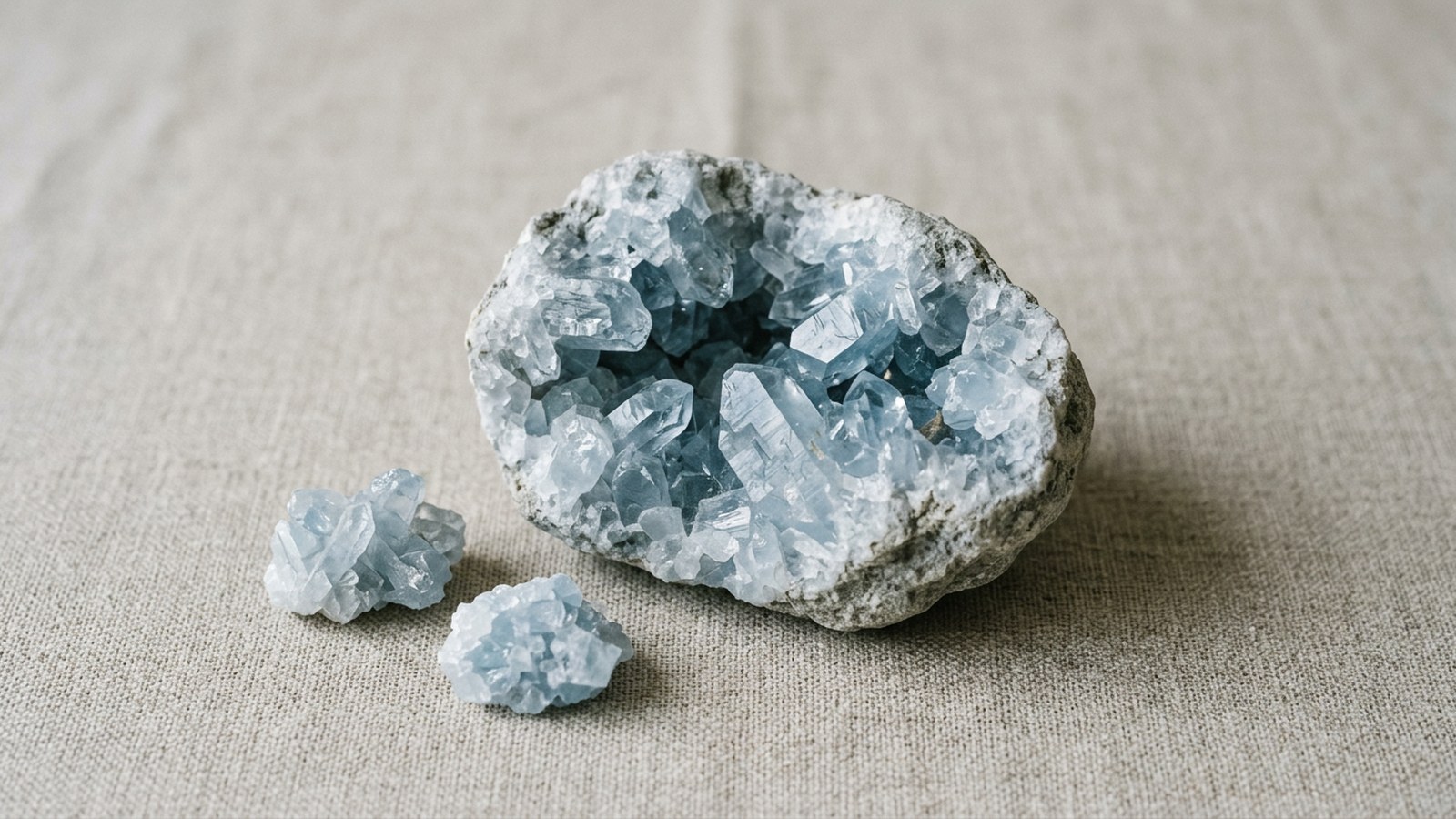
The celestite geode on my bedside shelf came from Madagascar, wrapped in newspaper, and it shed a few tiny blue flakes the first week I had it. It is the size of a cupped hand, grey and rough on the outside, and when you tilt the open side toward a lamp the crystals inside catch the light the way a clear winter sky does just before evening. I keep it in the one corner of the room the sun never reaches, and I will explain why further down, because it matters more than most guides admit.
Celestite meaning, in crystal tradition, centres on calm, gentle speech, dreams and a sense of being looked after. It is the stone people buy when the evenings feel loud and they want something on the nightstand that slows the room down. In this guide I cover what celestite is said to do, how it differs from angelite and blue calcite, what it really is as a mineral, where it comes from, whether it is safe to handle, and how to care for a crystal that is soft, slightly soluble and sensitive to light.
What is celestite?
Celestite (also called celestine) is a natural strontium sulfate mineral, SrSO4, best known for its pale sky-blue crystals that grow inside geodes. Its name comes from the Latin caelestis, meaning heavenly. In crystal healing it is linked with calm, communication, dreams and the throat, third eye and crown chakras. It is soft (Mohs 3 to 3.5) and fades in sunlight.
Reasons to work with celestite
Celestite is a stone for the end of the day. Many people who work with it describe the same habit: they place it where they wind down, on a nightstand or beside a reading chair, and treat a few minutes of looking at it as a signal that the busy part of the day is over. If your mind tends to replay conversations at night, this is the use I would start with, and it pairs well with the routines in my guide to crystals for sleep.
Celestite is a stone for softer words. Its traditional link with the throat chakra makes it a favourite for people who speak quickly when they are stressed, or who find it hard to say a difficult thing kindly. I like a small cluster on the desk before a call I am dreading, as a reminder to breathe before answering. You will find it alongside other stones for that purpose in crystals for communication.
Celestite is a stone for dream work. Practitioners keep it near the bed to help with dream recall and to set a quiet intention before sleep. If you are building a dream journal, it sits well with the practice I describe in crystals for dreams.
Celestite is a stone for people drawn to angel lore. It is often called the angel stone, and for those who pray, meditate or simply like the idea of unseen company, its colour seems to invite that kind of reflection. You do not need to share the belief to enjoy a few calm minutes with it.
Celestite meaning and healing energy
Emotional healing
Emotionally, celestite is read as a soothing stone for worry that runs in loops. Its pale colour and soft lustre are associated with patience and with a lighter mood after a tense day. For moments of acute stress I would still point you to the steadier options in my guide to calming crystals.
Spiritual healing
Spiritually, celestite is tied to the third eye and crown chakras and to the idea of contact with guides or angels. In meditation, many people hold a small piece in the palm or rest a cluster in front of them, keeping their gaze on the blue while the breath slows. My notes on meditating with crystals explain how I set that up.
Mental healing
On the mental side, celestite is associated with clarity of expression, finding the right words, and with the kind of mental quiet that makes it easier to think through a problem. Some people keep it near a journal for exactly that reason.
Physical healing
Traditional lore links celestite with the throat, with relaxation of tension and with restful sleep. This is folk tradition and personal experience, not medical advice: a crystal does not treat any condition, and a sore throat or ongoing insomnia deserves a doctor.
Celestite properties at a glance
- Chakras: throat, third eye, crown
- Zodiac signs: Gemini, Libra
- Element: air
- Numerical vibration: 2
- Intentions: calm, dreams, intuition
- Affirmation: "I speak gently, I rest deeply, and I trust that I am looked after."
Celestite vs angelite and blue calcite
These three soft blue stones are confused constantly, and two of the four questions people most often ask about celestite are about telling them apart.
Angelite is anhydrite, a calcium sulfate (CaSO4) found mostly in Peru. It comes as an opaque, massive stone that is usually tumbled or carved, with a soft powder-blue colour and no visible crystals. You will often read that angelite is celestite compressed over millions of years. It is a separate mineral with different chemistry, and nothing in its formation involves celestite turning into it. Celestite is almost always sold as transparent to translucent crystals, in clusters or geodes.
Blue calcite (calcium carbonate) is the other common mix-up. It is lighter in the hand, often a waxy turquoise-blue, and a drop of vinegar on a hidden spot makes it fizz faintly, which celestite never does.
The simplest test is weight. Celestite has a specific gravity of about 3.96, so it feels surprisingly heavy for its size, much heavier than calcite at about 2.7. Blue barite, its close cousin, is heavier still at around 4.5. In tradition the two angel stones share calm, with celestite read as the more airy and dreamy of the pair and angelite as the steadier one.
How to activate celestite
"Activating" a crystal is a ritual of intention, and with celestite the method has to respect its softness. Here is the way I do it with a new piece.
- Let it rest dry for a night on a windowsill under moonlight, or beside a selenite plate, since both methods involve no water or sun.
- Hold it in your palm for a minute and breathe slowly, keeping your eyes on its colour.
- Say your intention aloud, briefly, for example "help me rest" or "help me speak kindly."
- Place it where you will see it at the time you want that intention: by the bed, by the desk, by the meditation cushion.
My wider guide on how to charge crystals lists other gentle methods. With celestite, skip anything involving salt, sunlight or soaking.
Celestite geology
Celestite belongs to the barite group of sulfate minerals and crystallises in the orthorhombic system, usually as flat tabular or bladed crystals with a glassy to slightly pearly lustre. It is soft, with a Mohs hardness of 3 to 3.5, so a steel knife scratches it, and it has perfect cleavage, which is why geodes shed small flakes when knocked. Colours range from colourless and white to pale blue, with rarer yellow, orange and reddish crystals. The blue is generally attributed to tiny defects in the crystal structure, known as colour centres, and those defects are what make the colour light-sensitive.
Most celestite forms in sedimentary rocks, especially limestones, dolomites and evaporite beds, where strontium-rich fluids fill cavities and grow crystals inward, creating the familiar geodes. One of its oddest occurrences is alive: tiny marine protists called acantharians build their star-shaped skeletons out of celestite, which then dissolve back into the seawater after they die.
The German geologist Abraham Gottlob Werner named the mineral in 1798, after the Latin caelestis, for the colour of the first specimens. The International Mineralogical Association uses the name celestine, while celestite came into English through the American mineralogical tradition. Both refer to the same mineral.
Is celestite rare? Where it comes from
Celestite is a common mineral and the world's main commercial source of strontium, so it is not rare. Fine crystal clusters with a strong, even blue are less common, and those are the pieces that command higher prices.
The geodes most people own come from Madagascar, especially the Sakoany deposit in the Mahajanga region, where geodes are dug from soft sedimentary beds near the coast. Other classic localities include Sicily, where celestite grew alongside bright yellow native sulfur in the old sulfur mines around Agrigento, and Mexico, Poland and England. The most famous single occurrence is Crystal Cave on South Bass Island in Lake Erie, Ohio, found in 1887 by workers digging a well for Gustav Heineman's winery. It is often described as the largest known geode, a hollow lined with blue celestite crystals that visitors can walk inside.
Celestite history and lore
Celestite's history is tied to strontium. In 1790 the chemist Adair Crawford recognised a new earth in a mineral from the lead mines of Strontian in Scotland, and Humphry Davy isolated the metal in 1808. Celestite became the main ore of strontium, and that is how it reached the fireworks industry: strontium compounds produce the deep red in many fireworks and road flares.
Its angelic associations are much younger. The name angel stone belongs to the modern crystal movement of the late twentieth century, inspired by the mineral's heavenly name and colour, so I treat it as contemporary lore that many people find meaningful.
Is celestite safe to handle?
Holding, carrying or displaying celestite is safe. The word strontium worries some people because of strontium-90, a radioactive isotope produced by nuclear fission. Natural celestite contains only stable strontium, so it is not radioactive.
Celestite does dissolve very slightly in water, roughly a tenth of a gram per litre, and it should not be eaten or used for direct gem elixirs. Keep it away from small children and pets who might chew flakes, and wash your hands after handling a crumbly geode. If you like crystal water, use the indirect method from my guide to crystals and water safety, with the stone in a sealed glass outside the water.
Caring for your celestite
Celestite needs a little more care than most crystals on a shelf, mainly because of its softness and its light-sensitive colour.
- Keep it out of direct sun. Weeks of sunlight on a windowsill can bleach the blue toward grey or white, and the loss is permanent.
- Keep water brief. A quick rinse in cool water is acceptable for a solid cluster, dried at once with a soft cloth. Do not soak it, and never use salt, which scratches and can work into the crystals.
- Dust it gently. A soft makeup brush or a puff of air clears the inside of a geode without catching the crystal edges.
- Store it on its own. Harder stones such as quartz will scratch it. Give it a padded spot, as I suggest in how to store crystals.
- Cleanse it without contact. Smoke, sound, moonlight or a night on selenite all work. My guide to cleansing crystals covers each method.
Living with celestite
Celestite asks for very little: a shaded corner, a soft brush now and then, and a moment of your attention at the end of the day. If you want a companion, I would place it beside amethyst for quiet nights or blue lace agate for gentle conversations, then simply notice how the room feels after a week. However you read the angel stone lore, I hope it gives your evenings a little more quiet.