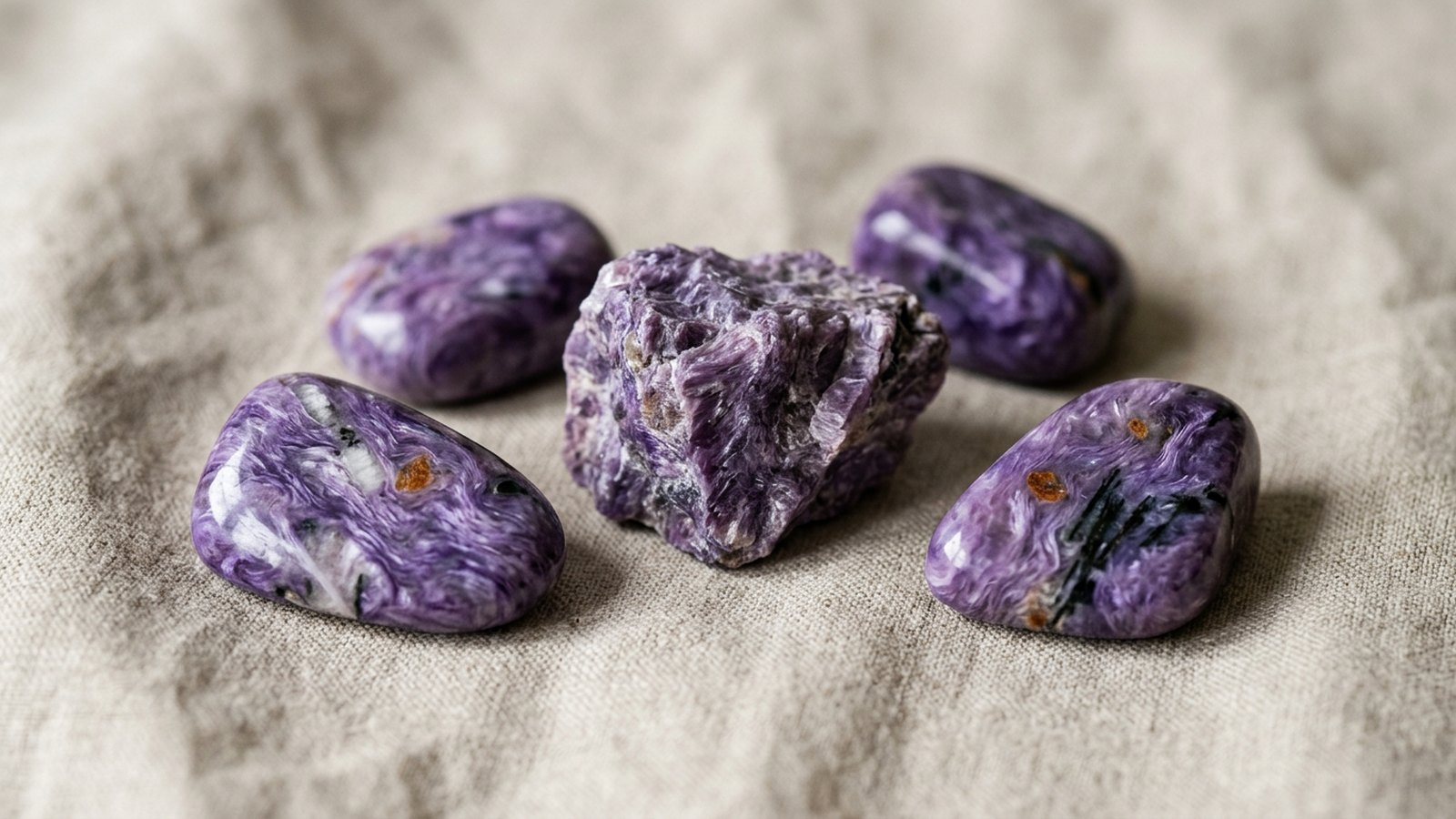
The first piece of charoite I held was a flat, polished slab about the size of a playing card, and I spent a long time turning it under a desk lamp before I put it down. The purple moves. It runs in fibrous swirls of lilac, violet and a deep grape colour, with white streaks through it and the odd needle of black, and when you tilt it the light slides across the fibres the way it slides across brushed silk. Photographs flatten it. In the hand it looks almost liquid.
What stayed with me longer than the colour was the feeling of the stone. Charoite has a quiet, steady presence that I associate with the evening, the hour when the day's noise is over and whatever you have been avoiding comes back to sit with you. That is the territory it is traditionally given: fear, change, and the slow work of letting go of something that has run its course.
If you want the short answer, charoite meaning in crystal tradition centres on transformation and courage in the face of change, with a strong link to the crown and third eye chakras. The longer answer includes a piece of geology that explains why the stone exists in only one place on Earth, an honest look at its history (which is younger than most sellers suggest), and practical notes on quality, fakes and care.
Reasons to Work With Charoite
Charoite is for the period after a decision, when the old situation has ended and the new one has not yet taken shape. A move to a city where you know nobody, the months after a separation, the first year of retirement. People who work with it often describe it as company for that in-between stretch, a way of staying present while the ground is still shifting. It sits naturally beside the stones in my guide to crystals for new beginnings.
Charoite is for fears that have outlived their reason. Many of us carry reflexes from an earlier chapter of life: bracing for criticism that no longer comes, saying yes out of an old need to keep the peace. Tradition gives charoite the job of loosening those patterns, and I find it a useful object to hold while writing down, plainly, what I am still afraid of and whether that fear still fits my life.
Charoite is for restless nights. It is one of the stones most often placed on a bedside table by people whose minds replay the day at two in the morning, and it has a reputation for softening vivid or troubling dreams. I would keep it alongside ordinary sleep habits, and my crystals for sleep guide covers the stones I pair it with.
Charoite is for people who give a great deal of themselves to others. Carers, teachers, therapists and parents of young children tend to be drawn to it, and the traditional reading is that it helps you keep some of your own energy back while you go on helping. It is gentler at this than black tourmaline, which feels to me more like a wall than a boundary.
Charoite Meaning and Healing Energy
Emotional Healing
Emotionally, charoite is associated with releasing fear and with the kind of calm that comes from accepting a change you did not choose. It suits grief that has moved from the sharp early phase into something longer and quieter, and I often mention it to readers of my crystals for grief guide. Its energy is soothing without being sleepy.
Spiritual Healing
This is where most practitioners place charoite first. It is linked to the crown and third eye chakras and is used in meditation to deepen intuition and to trust what you already sense. Some traditions call it a stone of spiritual service, meant for people who want their inner practice to show up in how they treat others. If you work with the upper chakras, my chakra crystals guide shows where it fits among the violet stones.
Mental Healing
Mentally, charoite is said to help with overthinking and with decisions that keep getting postponed. I use it as an anchor during journaling: holding it while I write gives my hands something to do and my thoughts a slower pace. If anxiety is the main issue, the stones in my crystals for anxiety guide are a better starting point, with charoite as a companion.
Physical Healing
Crystal healers associate charoite with rest, with easing tension headaches and with general recovery after exhaustion. These are traditional and intuitive associations only. Charoite does not treat any condition, and anything that affects your health belongs with a doctor.
Chakras: Crown and third eye Zodiac signs: Sagittarius and Scorpio Element: Water, in most modern crystal lists Numerical vibration: 6 (a modern numerology convention) Affirmation: "I let go of what I have outgrown and trust the next step."
Charoite Geology
Charoite is a silicate mineral with the approximate formula K(Ca,Na)2Si4O10(OH,F)·H2O, although mineralogists still argue over its exact structure, which was only fully worked out in 2010. It crystallises in the monoclinic system but almost never forms visible crystals. It grows instead as masses of fine, interlocking fibres, and those fibres are responsible for its silky, sometimes chatoyant sheen. It sits at 5 to 6 on the Mohs scale, softer than amethyst and quartz, and it is relatively light, with a specific gravity around 2.5 to 2.8.
The stone you buy is technically a rock, sometimes called charoitite, made of charoite mixed with other minerals. The colours tell you which ones:
- Purple, lilac and violet: charoite itself, coloured mainly by manganese.
- Orange to amber flecks: tinaksite, a rare calcium titanium silicate.
- Black or dark green needles: aegirine, a pyroxene.
- White streaks: microcline feldspar, with quartz and calcite in some pieces.
Why Charoite Is So Rare
Charoite is known from a single commercial deposit, in the Murun massif on the border of the Sakha Republic (Yakutia) and Irkutsk Oblast in eastern Siberia. The massif is an unusual body of alkaline igneous rock, very rich in potassium. Where that magma pushed into older limestone, heat and chemically active fluids reworked the contact zone, a process geologists call metasomatism, and charoite formed in that narrow band. The combination of rocks, chemistry and temperature appears to be unique, which is why nobody has found a second workable source.
The name comes from the Chara River nearby. In Russian the river's name starts with the "ch" of "chair", so CHAR-oh-ite is closest to the original, although SHAR-oh-ite is common in English and nobody at a crystal fair will correct you.
History of Charoite
Here I want to be honest, because the history of charoite is short and a good deal of what circulates about it is invented. Soviet geologists first noticed the purple rock in the Murun area in the 1940s, and it was formally described as a new mineral by Vera Rogova in 1978. There are no ancient cultures, shamanic legends or medieval lapidaries behind it. When a product page describes charoite as an ancient sacred stone, the claim has no documented source.
What charoite does have is a modern history of its own. It entered Western rock shops in the late 1970s and 1980s as a Soviet curiosity, became a favourite of lapidaries for cabochons, carvings and boxes, and was absorbed into crystal healing within a decade. Its meanings were built by modern practitioners from the feel of the stone and its violet colour. I think that is worth knowing, and it does not make the stone any less meaningful to work with.
What High Quality Charoite Looks Like
Because it comes from a single source and the finest material is limited, charoite is graded mostly by eye. When I buy it, I look at four things:
- Depth of colour. The most valued pieces are a saturated, even violet. Pale, greyish or patchy lilac sells for much less.
- Chatoyance. Good charoite shows a moving silky sheen when tilted. Dull, grainy pieces are lower grade.
- Inclusions. A little tinaksite and aegirine is normal and many collectors like it, but heavy black or white patches reduce value.
- Treatment. Much lower grade charoite is stabilised with resin to hold it together. That is acceptable if it is disclosed.
As for value, charoite is a semi-precious ornamental stone, priced by the piece or by weight. Small tumbled stones are inexpensive, while large, deeply coloured slabs, fine cabochons and carvings from old stock command real money. Supply from Russia has been irregular for years, so prices move more than for most stones.
Real Charoite or a Fake?
Charoite is imitated less than turquoise or lapis, but confusion is common. My guide to telling if a crystal is real covers the general method. For charoite, these are the usual suspects:
- Sugilite: another rare purple silicate, often more magenta and less fibrous, without the swirling sheen.
- Lepidolite: a lilac mica that sparkles with tiny flakes and feels softer and flaky at the edges.
- Dyed stones: howlite, magnesite or agate dyed purple. Look for colour pooling in cracks, and a cotton pad with a little acetone will often lift dye.
- Glass and resin: too uniform, often with bubbles, and warm to the touch too quickly.
Charoite is never transparent and never grows as pointed crystals, so a clear purple point is quartz, not charoite.
Charoite vs Amethyst
This is one of the most common searches, and the two are easy to separate. Amethyst is transparent to translucent quartz that grows as crystals and clusters, at a hardness of 7. Charoite is opaque, fibrous, swirled and softer. In tradition, amethyst is the calmer, more protective of the two, while charoite is associated with change and moving through fear. They combine well: amethyst for steadiness, charoite for release.
Where Charoite Comes From and How to Care for It
Every genuine charoite traces back to the Murun area in Siberia. If a label names another country, it refers to where the stone was cut or sold.
At 5 to 6 on the Mohs scale and with a fibrous structure, charoite needs some care:
- Keep it away from harder stones in storage; my crystal storage guide has simple ideas.
- Avoid salt, soaking and ultrasonic cleaners. A quick rinse and a soft cloth are enough, and my crystals and water safety guide explains why.
- Avoid heat and harsh chemicals, and keep resin stabilised pieces out of strong sun.
- For energetic cleansing, choose smoke, sound or a night on selenite. My guide to cleansing crystals covers each method.
In jewellery, charoite does best in pendants and earrings. Rings and bracelets take knocks, so protective settings are worth it.
Living With Charoite
I keep my first slab on a shelf by the window where I write, and I pick it up most often at the end of a day that has asked me to change my mind about something. It will not make a transition easy, and it makes no promise about the outcome. What it offers, in my experience, is a steady, beautiful thing to hold while you do the hard part yourself.
If charoite speaks to you, pair it with smoky quartz for grounding, or with labradorite when intuition is the focus. And if you would like to try it in quiet practice, my guide to meditating with crystals is a gentle place to begin.