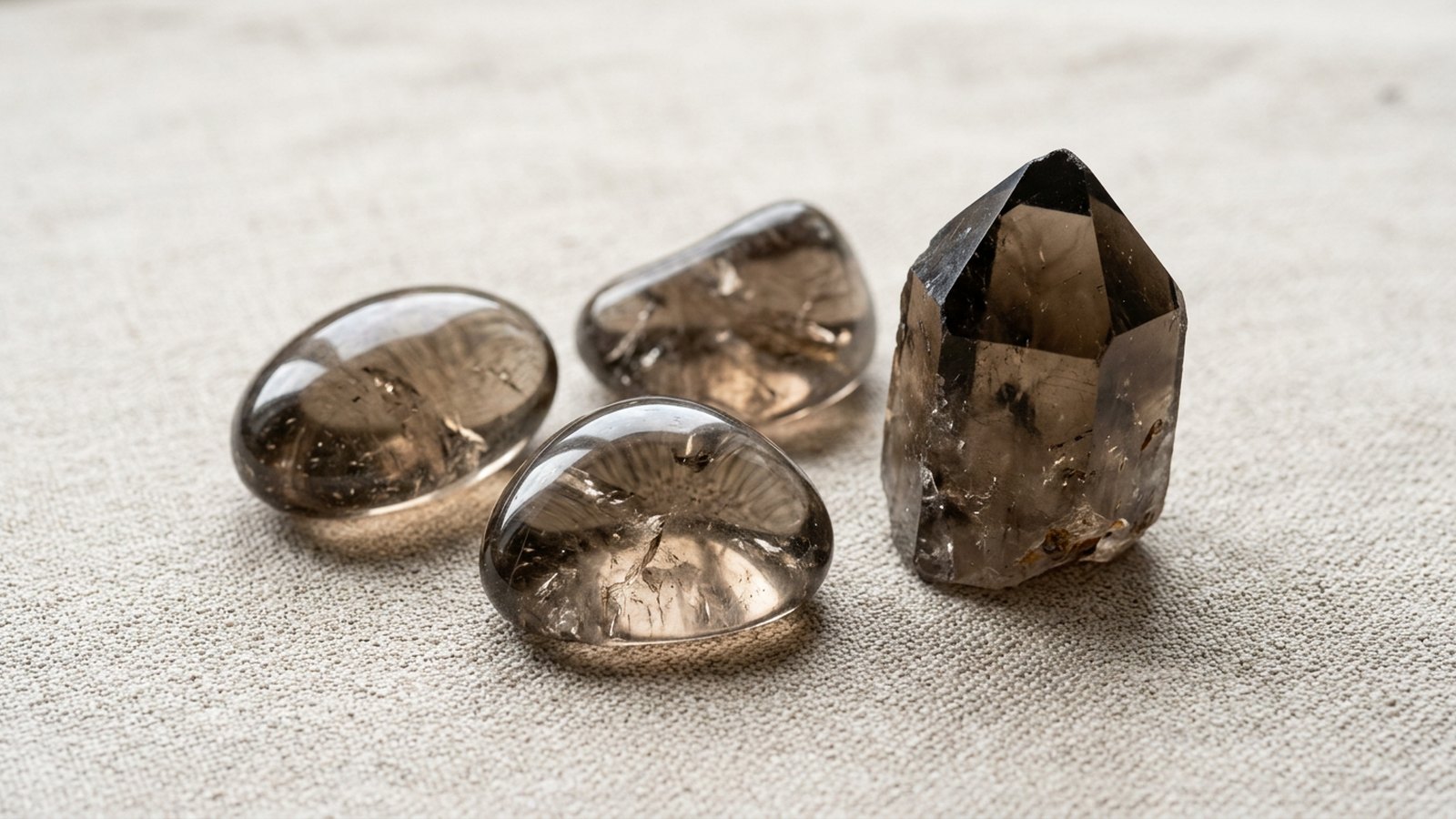
The specimen that sent me down this path was a small Namibian point bought at a mineral fair, sold to me as amethyst. At home, under a desk lamp, I noticed that its tip held a faint brown haze over the violet, as if someone had breathed smoke into the top of the crystal. The dealer had not mentioned it. It turned out to be smoky amethyst, a single crystal carrying both colours, and it made me look at a pairing I had been using for years with fresh eyes.
Smoky quartz and amethyst are one of the most natural combinations in a collection, in the literal sense: they are the same mineral, they often grow in the same pockets, and sometimes in the same crystal. This guide covers why the two agree, what each one brings, how I place and wear them, how to read a piece that shows both colours, what the pair is not for, and the honest answer to the question people ask most often, which is what not to put next to them.
Smoky quartz and amethyst together: the short answer
Yes, smoky quartz and amethyst work very well together, and they are among the easiest stones to combine. Both are quartz, both rate 7 on the Mohs scale, and in crystal tradition they cover two ends of the same need. Smoky quartz is read as grounding and steadying, a stone for the body and the present moment. Amethyst is read as calming and clarifying, a stone for a busy mind and for rest. Together they are used for what people often call grounded calm: quieting the head while staying settled in the body, which is why the pair turns up so often beside beds and on meditation cushions.
Why the pair agrees: two colours of one mineral
This pairing has a mineral logic as well as a traditional one, and I think it is the most interesting thing about it.
Clear quartz is silicon dioxide, SiO2, arranged in the trigonal crystal system. As it grows from hot, silica-rich water in veins and cavities, small amounts of other elements slip into its structure. Amethyst carries traces of iron. Smoky quartz carries traces of aluminium. On their own, neither impurity produces much colour. The colour appears later, when the crystal is exposed over very long periods to low-level natural radiation from uranium, thorium and potassium in the surrounding rock. That radiation knocks electrons out of place around the iron or aluminium sites and creates what mineralogists call colour centres, tiny defects that absorb part of the light passing through. Iron-based centres give violet. Aluminium-based centres give the brown to grey of smoky quartz.
You will sometimes read that smoky quartz is coloured by "free silicon". That idea circulates widely online, including in AI summaries, but the accepted explanation today is the aluminium colour centre. The difference matters for one practical reason: colour centres are fragile under heat. Heat amethyst to a few hundred degrees and its violet turns yellow to orange, which is how most citrine on the market is made. Heat smoky quartz and it clears. The two stones share the same skeleton and the same kind of colour, switched on by the same natural process.
So when people say the pair feels harmonious, there is a physical story under the intuition. You are holding two variations of one crystal, coloured by two different traces of metal, in the same rock, under the same slow radiation.
What each stone brings to the pair
Smoky quartz sits at the root chakra in most systems, and its traditional themes are grounding, protection and letting go of tension. It is the stone people reach for when they feel scattered, over-stimulated or anxious in a physical way, with a tight chest or restless legs. Its earthy colour has a lot to do with that reputation, and in my hands it is the heavier, more inward-feeling of the two, even though both have the same density. I use it as an anchor, and it appears in my lists of crystals for grounding and protection.
Amethyst is linked with the crown and third eye chakras. Tradition associates it with calm, intuition, sobriety (its Greek name, amethystos, means "not intoxicated") and peaceful sleep. It is also the February birthstone. Amethyst is used for the mind: racing thoughts at night, mental clutter, the feeling of being unable to switch off. It appears in my guides to crystals for sleep and crystals for anxiety.
Put together, the pair spans the chakra column from base to crown, which is part of why energy workers like it for full-body meditations. The common complaint about amethyst on its own is that it can feel dreamy or heady for some people. Smoky quartz answers that by keeping attention in the body. The reverse is also true: smoky quartz alone can feel heavy on a low day, and amethyst lifts it.
When both grow in one crystal: smoky amethyst
Because amethyst and smoky quartz form in similar conditions, it is common to find them on the same matrix, and less common but well documented to find both colours inside one crystal. The best-known source is the Brandberg area of Namibia, whose crystals often show violet zones, smoky zones, ghostly phantoms of earlier growth stages, and sometimes small fluid inclusions with a moving bubble. Similar mixed pieces come from parts of Brazil and the United States.
What you are seeing in such a crystal is a record of changing chemistry. The fluid feeding the crystal carried more iron in one phase and more aluminium in another, and later radiation coloured each zone according to what it had captured. A piece like this is, in effect, the pairing grown into a single crystal, and it is a lovely thing to hold during the practices below.
If you think you have a smoky amethyst, hold it against a white sheet of paper in daylight and turn it slowly. True amethyst zones stay violet from most angles and often sit in the terminations; smoky zones read as brown or grey and can blur into the purple. A dark, almost black, perfectly even "smoky quartz" with no zoning at all is often clear quartz that has been artificially irradiated, a common and legal treatment that should still be disclosed. Glass sold as amethyst usually shows round bubbles, swirl lines and a slightly warm feel against the cheek. My guide on how to tell if a crystal is real goes through these checks in more detail.
How I use smoky quartz and amethyst together
These are the five ways I come back to most often. The logic in all of them is the same: smoky quartz goes low or close to the body, amethyst goes higher or closer to the head.
- Seated meditation. Place a piece of smoky quartz on the floor between your feet or in your lap, and hold amethyst in your hands or rest it at the level of your heart. Breathe slowly for ten minutes, letting your attention drop to the weight of the smoky quartz on the out-breath. If you already practise, my guide to meditating with crystals has longer sequences.
- Bedside, for wind-down. Amethyst on the nightstand near your head, smoky quartz lower down, on a shelf or under the bed near your feet. Handle the amethyst for a minute as part of switching off your screen. That small ritual is where most of the benefit comes from.
- Desk, for a long day. A smoky quartz point near your keyboard and a small amethyst cluster at eye level. I use them as a reminder to stand up, look away from the screen and breathe, nothing more.
- A bracelet or a pair of tumbles. Because both are quartz, a mixed bracelet wears evenly and neither stone grinds the other down. In a pocket, carry one tumble of each. See carrying and wearing stones for what suits rings versus pendants.
- The entrance of a home. Smoky quartz by the door for the protective, settling tradition, amethyst in the room where you rest. I find this spread across two rooms calmer than placing both together on one shelf.
Is it good to sleep with smoky quartz?
It is one of the questions searchers ask most, so I want to answer it plainly. In crystal tradition, smoky quartz can support sleep for people whose restlessness is physical, and amethyst is the more usual choice when the problem is a busy mind. Some people find smoky quartz too heavy right under the pillow and prefer it at the foot of the bed. Nothing about it is unsafe: a tumbled stone near your bed is harmless, though I would not sleep with a pointed crystal under your head. If poor sleep goes on for weeks, that deserves a conversation with a doctor, and no stone replaces it.
What not to pair with smoky quartz or amethyst
Lists of stones "you should never combine" are popular, and my own guide on what crystals should not be together looks at them closely. For this pair, here is my honest reading.
There is no physical conflict between smoky quartz, amethyst and other quartzes such as clear quartz or citrine. The cautions you will find are about intention. Traditionally, people avoid putting very stimulating stones such as carnelian or bright citrine next to amethyst when the goal is sleep, simply because the two point in different directions. That is a matter of purpose, and it is easy to respect.
The real-world issue is hardness. At Mohs 7, both stones will scratch softer stones they rub against in a pouch or a dish: selenite (2), calcite (3), malachite (around 3.5 to 4) and fluorite (4) all end up marked. Store those separately.
Pairs I happily recommend alongside this one: black tourmaline with smoky quartz for a stronger protective anchor, and amethyst with moonstone or amethyst with rose quartz when the aim is gentleness more than grounding.
What the pair is not for
Smoky quartz and amethyst will not treat anxiety, insomnia or depression, and claims that smoky quartz "absorbs radiation" from phones and wifi have no basis. What the pair offers is a tactile, visual cue that helps you slow down, breathe and come back to your body, and I find that genuinely useful. Use it alongside real care when you need it, never instead of it.
Caring for smoky quartz and amethyst
Both are robust, but their colour is the delicate part. Keep amethyst out of strong direct sun, because long exposure on a windowsill can pale it over months, and keep both away from heat sources such as radiators or a car dashboard, since heat is exactly what undoes their colour centres. Water is safe for both for rinsing; dry them afterwards and avoid sudden hot to cold changes, which can crack included pieces. For cleansing, smoke, sound or a night on a selenite plate all work; my cleansing guide and the notes on crystals and water safety cover the rest.
A last word
If you are building a first small collection, this is one of the pairs I would start with. It costs little, it is hard to damage, and the two stones teach you something real about how crystals form. Pick the pieces you like to hold, put the smoky one low and the violet one high, and notice how you feel after a week.