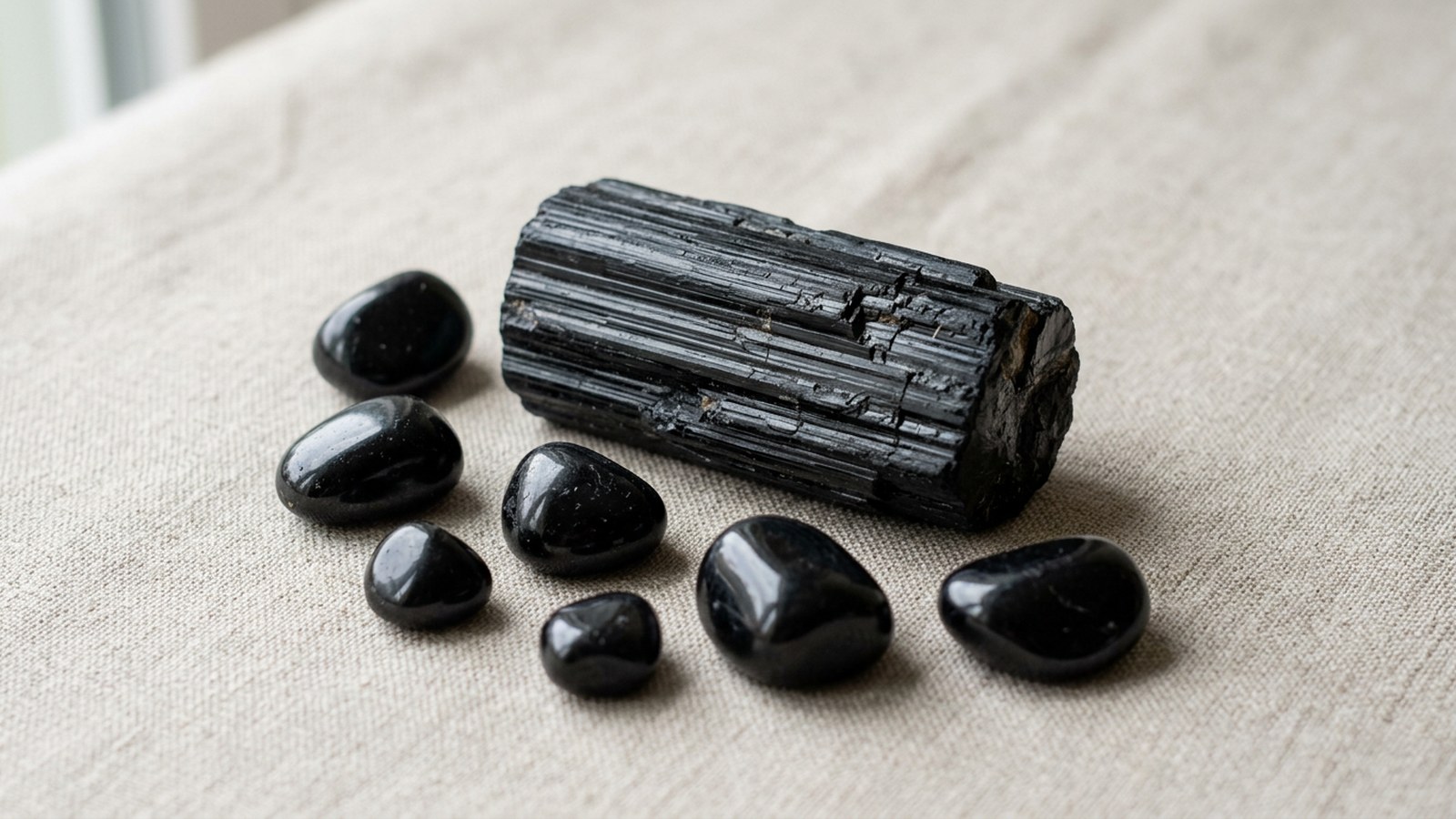
The first black tourmaline I ever bought was a rough, finger-length column from a dealer's tray at a mineral fair, matte and striped along its length like a bundle of black pencils. I put it on the shelf by my front door because that was where the books said protection stones belong. A few weeks later a friend gave me a small amethyst cluster, and it went on my bedside table. Those two pieces have stayed in those two places for years, and between them they taught me most of what I know about why black tourmaline and amethyst are paired so often.
This guide covers what each stone is said to do, why the tradition treats them as companions, the practical ways to place and wear them together, the real geology underneath, the one care rule they do not share, the questions people ask about what should never be combined with either, and how to avoid fakes when you buy them as a set.
Can black tourmaline and amethyst go together?
Yes. Black tourmaline and amethyst are one of the most widely recommended crystal pairings, and nothing in their physical make-up or in mainstream crystal tradition argues against it. Black tourmaline is traditionally used for protection and grounding at the root chakra, and amethyst for calm, sleep and intuition at the crown and third eye. Both sit at about 7 on the Mohs scale, so they can share a bracelet or a pouch without scratching each other. The only care difference is light: amethyst fades in strong sun and black tourmaline does not.
Why the pair works in crystal tradition
Most crystal writers describe the two stones as doing different jobs that happen to fit together. In the tradition, black tourmaline is a boundary stone. It is linked to the root chakra, to the earth element and to the feeling of being steady on your feet, and it is the stone people reach for when they come home from a crowded day feeling as though they have carried other people's moods in with them.
Amethyst is described as working on the mind. It belongs to the crown and third eye chakras, it is the classic stone for quietening a busy head at night, and its very name comes from the Greek amethystos, "not intoxicated", from the old belief that it kept the wearer clear-headed.
Put together, the reasoning goes, one stone steadies your edges while the other settles your thoughts, so the pairing spans the body from root to crown. In my own experience the combination feels balanced in a way neither stone does alone. Black tourmaline on its own can feel heavy to some people, a dense, very still presence in a room. Amethyst on its own can feel a little floaty when what you really need is to get through an ordinary Tuesday. Together they read, to me, as calm and anchored at the same time. That is an intuition shared by a great many practitioners, and I offer it as tradition and personal feeling rather than anything measurable.
How to use black tourmaline and amethyst together
1. By the door and by the bed
This is the arrangement I use and the one I suggest to beginners. Black tourmaline goes near the entrance of your home, on a shelf or a windowsill by the door, where tradition says it filters what comes in. Amethyst goes by the bed, where it acts as a cue to let the day go. The guide to placing crystals in your home goes room by room if you want to extend this, and crystals for sleep covers the bedside side in more depth.
2. Worn together
A bracelet that mixes both stones is the most common way people carry this pair, and it is physically one of the safer mixed bracelets you can buy, because the two materials are equally hard. If you follow the receiving and giving hand tradition, many people wear a protective stone on the left wrist, which is said to receive energy. The reasoning is laid out in which hand to wear a crystal bracelet on. A small black tourmaline pendant with an amethyst ring works just as well if beads are not your style.
3. In meditation
Sit with a piece of black tourmaline on the floor between your feet and an amethyst held loosely in your hands or resting in your lap. Breathe slowly for five or ten minutes, with your attention first on the weight of your body and the floor, then on the quiet behind your eyes. The layout simply puts each stone near the chakra it is associated with. Meditating with crystals has fuller practices if this one suits you.
4. On a desk
People often place the two stones beside a computer. I keep a tumbled amethyst and a small tourmaline near my keyboard, mostly as a reminder to look up, breathe and drink some water during long screen sessions. That reminder is useful. The claim that the stones neutralise radiation from the screen needs its own section.
The EMF claim, honestly
Almost every page about this pair says black tourmaline absorbs electromagnetic radiation from phones and wifi. The idea has a real starting point. Tourmaline is both piezoelectric, producing a small electric charge when squeezed, and pyroelectric, producing one when heated or cooled. Dutch traders in the eighteenth century noticed that warm tourmaline crystals pulled ash out of their pipes and called them aschentrekkers, ash pullers, and Linnaeus referred to the mineral as lapis electricus. Quartz, which includes amethyst, is piezoelectric too, which is why quartz crystals keep time in watches.
Those effects are genuine, and they are tiny. They have nothing to do with absorbing radio waves, and no controlled study has shown that a piece of tourmaline on your desk changes the electromagnetic field around a phone or router. If EMF exposure worries you, distance and time are the factors that actually change it. I still keep my tourmaline by the computer, and I keep it there for the pause it prompts. If the stones help you feel calmer while you work, that is a perfectly good reason to keep them there.
The geology: two hard stones from different places
Black tourmaline is the mineral schorl, a sodium iron aluminium borosilicate and by far the most common member of the tourmaline group. It crystallises in the trigonal system, so a clean crystal has a rounded triangular cross-section with fine grooves running along its length. It forms mostly in granite pegmatites, coarse-grained pockets of the last melt to cool in a granite body, and good specimens come from Minas Gerais in Brazil, the Erongo Mountains of Namibia and northern Pakistan. The word tourmaline comes from the Sinhalese turmali, a name used in Sri Lanka for mixed coloured gem pebbles, and schorl is an old German miners' term.
Amethyst is purple quartz, silicon dioxide. Its colour comes from traces of iron in the crystal lattice combined with natural irradiation over geological time. Most of the amethyst sold today grows inside gas cavities in ancient basalt lava flows, the famous geodes of Rio Grande do Sul in Brazil and Artigas in Uruguay, while deeper-coloured material is mined from veins in Zambia.
The two stones almost never grow in the same rock, yet they behave very similarly in your hand. Schorl is about 7 to 7.5 on the Mohs scale and amethyst is 7, so neither will scratch the other noticeably on a shared bracelet or in a pouch. The one physical quirk worth knowing is that a raw black tourmaline piece is usually a bundle of columns grown side by side. It is brittle along those joins and tends to shed small black grit, so keep raw tourmaline away from softer stones such as selenite, and expect a little dust on the shelf.
Caring for both stones
The rule the two stones do not share is light. Amethyst fades in sustained direct sunlight, sometimes within a season on a bright windowsill, because the colour centres that make it purple are sensitive to light and heat. Heat it to roughly 400 to 500 °C and most amethyst turns yellow or orange, which is how much commercial citrine is made, a story told in amethyst and citrine together. Black tourmaline does not fade at all.
So if you cleanse or charge your stones in the sun, take the amethyst out of the routine. A shared method that suits both is moonlight overnight, a few minutes of sound from a bell or singing bowl, or a rest on a selenite plate. A quick rinse under the tap and a dry with a soft cloth is fine for either stone, though I avoid salt water for anything in a metal setting or on an elastic cord. The full range of options is in the guide to cleansing crystals.
What cannot be paired with black tourmaline or amethyst?
Search for either stone and you will find lists of forbidden combinations. For black tourmaline the usual one is rose quartz, on the grounds that an open, receptive stone sends a mixed signal next to a protective one. For amethyst it is carnelian or citrine, energising stones said to pull against a calming one. These lists vary from site to site and often contradict each other, which is why I wrote what crystals should not be together. The physical rules are hardness, water and light, and this pair passes all three.
There is also a real system behind some of the warnings. In Vedic astrology amethyst, sold in India as jamunia, is a substitute stone for blue sapphire and is governed by Saturn, which is why some Indian gem guides caution against wearing it with stones of the Moon or Sun, as I explain in amethyst and moonstone. Black tourmaline does not appear in the classical texts at all. Some modern sellers assign it to Saturn as well, which would make this pair a harmonious one in that framework, though that assignment is a recent addition and not a traditional rule.
As for who should not wear black tourmaline, my practical answer is anyone allergic to the metal it is set in, anyone wearing a raw piece against sensitive skin (the edges can scratch), and anyone tempted to rely on it in place of real help when they feel unsafe. The stone itself is inert and harmless to handle.
What this pairing is not for
A black tourmaline and amethyst bracelet will not treat anxiety, insomnia or depression, and it will not keep anyone safe from a genuinely dangerous person or place. If sleep or anxiety is affecting your life, please speak to a doctor or a qualified therapist; crystals can sit alongside that care as a comfort and a cue, and never in place of it. I would also suggest this pair less for days when you need energy and drive. Both stones lean towards stillness, and for momentum a partner like citrine or carnelian makes more sense.
Buying the pair: spotting fakes
Because mixed bracelets are cheap and popular, they are where substitutions happen. Black beads sold as tourmaline are sometimes black glass, dyed agate sold as onyx, or obsidian, which has a glassy shine and a smooth conchoidal break. Real schorl beads tend to look slightly less glossy, feel heavy for their size, and sometimes show fine parallel lines or small pits where the striations were cut through. The differences with obsidian are covered in black tourmaline vs obsidian.
Amethyst fakes are usually glass, which can show tiny round bubbles and perfectly even colour. Natural amethyst nearly always has some colour zoning, paler and darker bands or patches, when you look closely in daylight. Lab-grown amethyst exists and is chemically identical, so a very cheap, flawless, intensely purple bead deserves a question. The general tests are in how to tell if a crystal is real.
A last word
If you want to try this pairing, start with my simple version: one piece of black tourmaline by the door and one amethyst by the bed, for a month, with no expectations beyond noticing how the rooms feel. If you enjoy the grounding side, black tourmaline and smoky quartz takes it further, and if the calm side speaks to you, smoky quartz and amethyst and the wider crystals for protection and calming crystals guides are good next reads. Whichever you choose, the stones will be at their most useful as reminders of the intention you set for them.