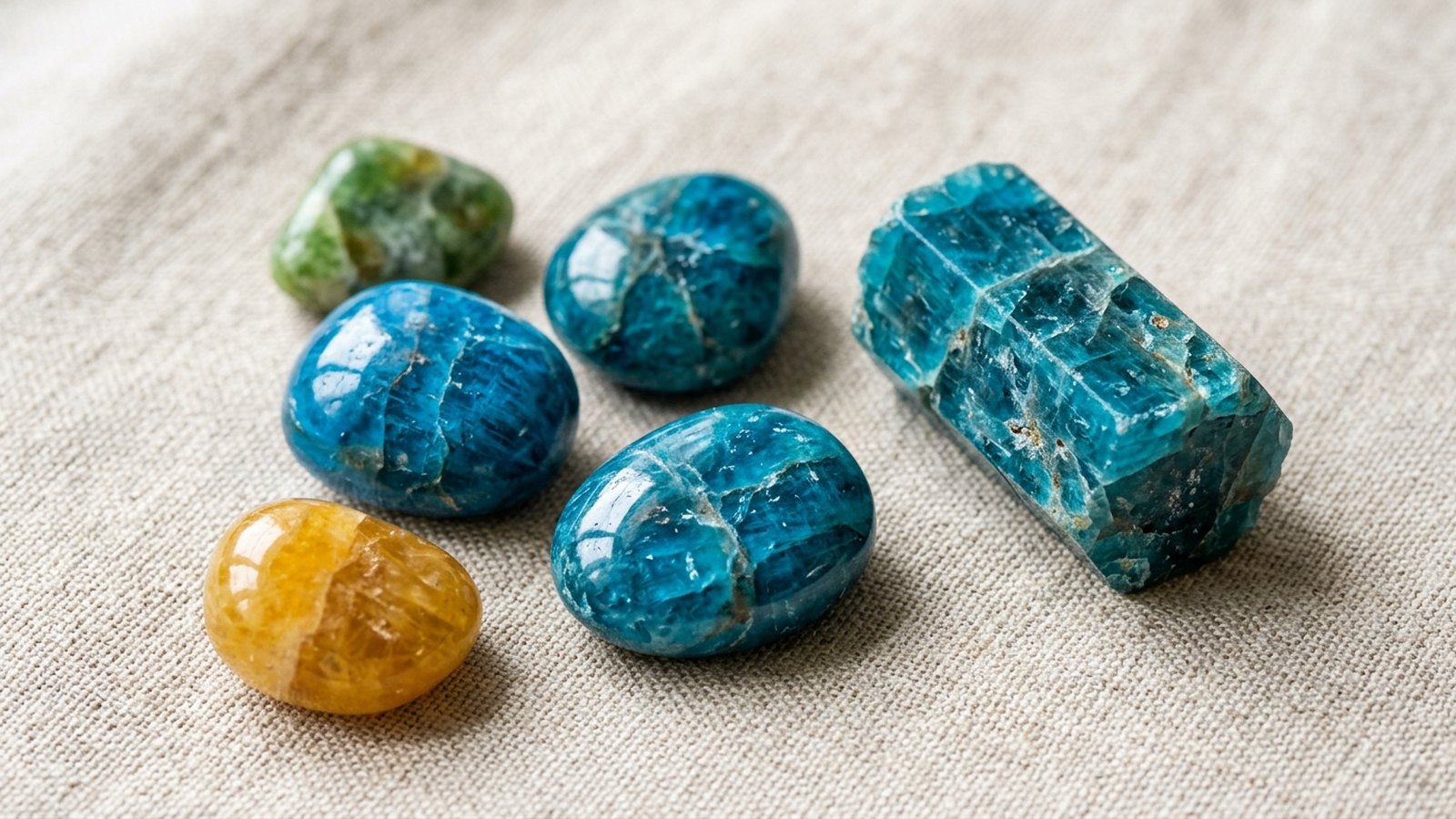
Apatite means "to deceive". The name comes from the Greek apatao, given to the mineral in 1786 because it kept being mistaken for other gems, and in crystal tradition apatite is the stone of clarity, motivation and honest speech: blue for the throat, green for the heart, golden for drive. It is also, oddly, the mineral your own teeth are made of.
The first piece I owned was a rough blue crystal the colour of a swimming pool at dusk, and what struck me was how lit it looked. Apatite has a way of holding light a half-shade brighter than it should, which is exactly the quality that got it into trouble with early mineralogists. Turn a good neon blue-green piece in your hand and you will see why someone once filed it under tourmaline and moved on.
I like apatite, and I think most of what is written about it online is wrong in the same four places. So this guide is organised around the name. Apatite deceives the eye, it deceives the lore, it deceives the wearer, and it deceives the buyer. Each one has a practical consequence, and none of them is a reason not to own the stone.
What You Are Actually Holding
Apatite is not one mineral. It is a small group of calcium phosphates with the general formula Ca5(PO4)3(F,Cl,OH), and the letter in that last bracket decides which one you have: fluorapatite, chlorapatite or hydroxylapatite. Fluorapatite is by far the most common, so the blue crystal on your shelf is almost certainly that.
It crystallises in the hexagonal system, which is why good specimens turn up as stubby six-sided prisms with a flat or shallow pyramid on the end. It forms in igneous rocks as an accessory mineral, in metamorphic rocks, and in vast sedimentary beds of phosphate rock laid down from the remains of marine life.
The colour range is wide: blue, that electric blue-green sometimes sold as neon apatite, grass green, golden yellow, violet, brown and colourless. Trace elements and substitutions inside the lattice do the work, with rare earth elements and manganese among the usual suspects.
One structural detail matters more than it sounds. Apatite has poor to indistinct cleavage, which you might read as good news, but it is also genuinely brittle. It does not split neatly along a plane so much as chip and fracture where it is struck. Hold that thought for the durability section.
Deception One: The Eye
Abraham Gottlob Werner named apatite in 1786, with material from the St Gotthard region of Switzerland, and he chose the name as a small joke at his colleagues' expense. The mineral had been catalogued repeatedly as something else.
The list of stones apatite has been mistaken for is a tour of the gem case: peridot for the green material, beryl and topaz for the blue, fluorite for the violet, and tourmaline for almost all of it. The confusion has not stopped. The most expensive-looking apatite on the market, that saturated blue-green from Madagascar, is regularly confused with Paraiba tourmaline, a stone worth many multiples of it.
If you want the practical version: apatite sits at a hardness where a steel blade will mark it and quartz will not be marked by it, which is the single fastest way to separate it from a beryl or a topaz that looks similar. Our guide on how to tell if a crystal is real covers the rest of the method. Blue-green apatite is also worth comparing against amazonite, which occupies a similar shelf in a lot of shops and behaves very differently.
What Apatite Is Reached For
In crystal tradition, apatite is a stone of the mind rather than the heart. It is described as a stone of manifestation, meaning the specific link between having an idea and doing something about it, and its reputation is clarity, motivation and the willingness to say the true thing out loud. I read all of this as tradition and personal intuition, not as fact, and I would not ask a stone to carry anything that belongs to a doctor or a therapist.
The associations split by colour, and this is one place the sources broadly agree:
| Colour | Chakra | Traditionally reached for |
|---|---|---|
| Blue | Throat | Honest speech, self-expression, saying the difficult thing |
| Deep blue to indigo | Third eye | Mental clarity, focus, dream recall |
| Green | Heart | Connection to the natural world, gentler ambition |
| Golden yellow | Solar plexus | Drive, confidence, follow-through |
Chakras: throat and third eye above all, heart and solar plexus by colour. Zodiac: modern crystal writers usually name Gemini, and less consistently Capricorn and Pisces. Be aware that this is recent. Gemmological sources are explicit that apatite is not a traditional birthstone or zodiac stone, and I would rather tell you that than pretend at an ancient pedigree. Element: air. Numerical vibration: 9. Affirmation: I say the true thing, and then I do the next thing.
If you came here from a need rather than a stone, apatite shows up on our lists for focus and creativity, and it is one of the tail entries on manifestation.
Deception Two: The Appetite Story
Search apatite for five minutes and you will meet the claim that it suppresses appetite. Some pages go further and suggest wearing it daily or drinking an elixir made from it for weight loss.
Here is where that comes from, as far as I can tell: apatite and appetite are near-homophones in English. That is the whole of it. The Greek root apatao means to deceive, and it was given for the mineral's habit of impersonating other gems. There is no old tradition here, no documented lore, and nothing in the etymology that points at hunger. A pun became a property, and the property got copied from page to page until it read like heritage.
I would leave the claim alone for two reasons. The first is that no stone regulates appetite, and appetite that has genuinely changed is a thing to raise with a doctor rather than a shelf. The second is the elixir advice, which I would ignore on principle: do not soak stones you intend to drink from, and see our note on crystals and water safety before soaking anything at all.
There is a useful half buried in it, though. Apatite's honest reputation is drive and initiative, the appetite for the work rather than for food, and that is a fair description of what people actually reach for it for.
Deception Three: The Wearer
Apatite is Mohs 5. That sentence is usually written as though it were a middling score, and it is worth understanding what it really means: apatite is the index mineral for 5. It does not sit near the definition of 5 on the Mohs scale, it is the definition. Friedrich Mohs picked it as the reference point in 1812 and it has held the slot ever since.
The practical translation is unforgiving. A steel knife blade is around 5.5, so ordinary steel scratches apatite. Household dust contains fine quartz at 7, which is why a stone wiped with a dry cloth over months comes back duller than you remember. Sand, keys and coins all win. So does a quartz countertop.
Combine that with the brittleness noted earlier and the format advice writes itself. Pendants, earrings and pieces that sit still are fine. A ring in daily wear is asking a soft, brittle stone to survive the single most abusive position in jewellery, and I would not do it. This is the same argument I make about fluorite, for the same reason.
For care: warm water, mild soap, a soft brush, dry it properly. Never an ultrasonic cleaner and never steam, because brittle stones with internal fractures are exactly what those machines find. Keep it out of prolonged direct sun and away from heat, since some blue apatite owes its colour to treatment and heat is the one thing that undoes what heat did. Store it separately rather than loose in a bowl with quartz and agate, which our guide on storing crystals goes into. For cleansing, dry methods suit it best: sound, smoke, moonlight, or a night on selenite. Salt water is a poor idea for a soft phosphate, and our cleansing guide explains why.
The Part Nobody Uses, and It Is the Best Part
Every crystal site tells you apatite connects to the body. Almost none of them mention the literal version, which is far more interesting than the metaphor.
Hydroxylapatite, one of the three apatite end members, is the mineral phase of vertebrate bone and tooth enamel. Your teeth are, in mineralogical terms, apatite. Not similar to apatite, not analogous to it: the same mineral family, grown by your own body. When you hold a piece of blue apatite you are holding the rock version of your own skeleton, and I have never found a crystal fact that lands harder with people.
The second unused fact is agricultural. The overwhelming majority of apatite mined on earth never sees a gem cutter. It is crushed into phosphate rock to make fertiliser, and phosphate rock is the only material available at the scale world food production needs. So the mineral that literally builds your bones also, at industrial scale, feeds you. The faceted stones are a rounding error on that tonnage.
None of this means apatite heals bones or teeth, and I want to be clear about that. It is not medicine, and nothing here replaces a dentist. It is simply a rare case where the traditional association and the physical reality point the same direction, which is more than most stones can claim.
Deception Four: The Buyer
Two things to know before you spend. First, some apatite is heat treated to improve or deepen its colour, particularly Madagascan material, and this is rarely disclosed at the shop end of the market. It is not a scandal, it is normal gem practice, but it is the reason to keep the stone away from sunny windowsills.
Second, apatite is genuinely inexpensive as gems go, and that is not a warning sign. It is soft, so it never entered the fine jewellery mainstream, and its price reflects that rather than any doubt about the material. If a piece is being sold at Paraiba tourmaline prices on the strength of a neon blue-green colour, walk away.
Main sources today are Brazil, Mexico, Madagascar, Myanmar and Russia, with the enormous Kirovsk deposit on the Kola Peninsula feeding the industrial side. For blue, Madagascar and Brazil dominate the gem trade.
How I Actually Use It
On a desk, out of the sun, where I can see it while I work. That is most of it. Apatite is a working stone rather than a comforting one, and I reach for it in the specific moment when I know what needs doing and have found four reasons not to start.
The other use is a conversation. Blue apatite belongs to the same throat territory as sodalite and lapis lazuli, and if you want the map of which stone sits at which centre, our chakra guide lays it out. I carry a tumbled piece in a pocket by itself, never with keys, on days I have something honest and unwelcome to say.
Apatite will not do any of this for you. What it will do is sit there being the colour it is, which turns out to be a reasonable amount of help. If you want a stone that argues gently for getting on with it, this is a good one to start with.