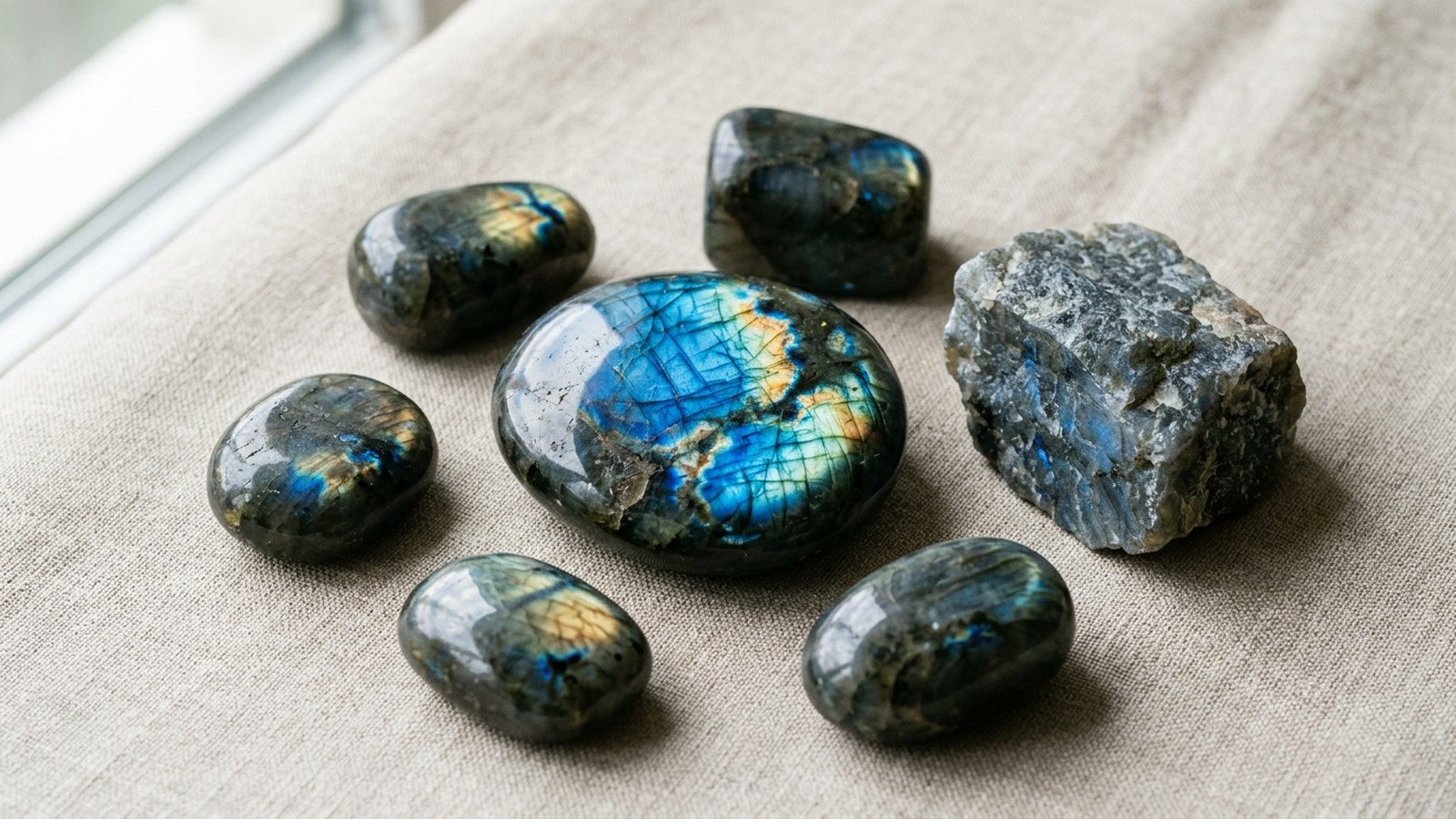
The first time I put amethyst and labradorite side by side, it was by accident. I had come home from a long day of meetings, emptied my pockets onto the desk, and there they were: a small amethyst point I keep for the evenings and a palm stone of labradorite I had carried all day. Under the desk lamp the labradorite flashed a cold peacock blue, and the amethyst sat next to it in its steady violet. They looked as if they had been chosen for each other, and over the years I have come to think that, in a practical sense, they were.
This guide covers what amethyst and labradorite mean together, why the pairing makes sense in crystal tradition, how I actually use the two, what the combination is less suited to, and the one physical problem that quietly ruins it if you are careless. Everything I say about energy reflects tradition and my own experience. None of it replaces medical or psychological care.
The short answer
Amethyst and labradorite pair well. In crystal tradition amethyst is the calming stone that settles an overactive mind, while labradorite is the stone of intuition and energetic boundaries, kept for staying clear among other people's moods. Both are associated with the third eye chakra, so they share a common focus on perception and insight. Physically they are compatible too, with one condition: amethyst (Mohs 7) is harder than labradorite (Mohs 6 to 6.5) and will scratch it, so store them apart and be thoughtful about wearing them on the same strand.
What each stone actually is
Amethyst
Amethyst is the purple variety of quartz, silicon dioxide, with a hardness of 7 and no cleavage. Its colour comes from traces of iron in the crystal lattice that have been altered by natural radiation over geological time. That colour is sensitive to heat and, more slowly, to strong light: heat it to a few hundred degrees and it turns yellow, which is how most commercial citrine is made. The name comes from the Greek amethystos, usually translated as "not drunk", from the old belief that the stone protected its wearer from intoxication. It is also the February birthstone.
Labradorite
Labradorite is a feldspar, and this answers a question people often ask: no, labradorite is not a quartz crystal. It belongs to the plagioclase series, a family of feldspars that runs in composition from sodium-rich albite to calcium-rich anorthite, with labradorite sitting toward the calcium side. It crystallises in the triclinic system and has two cleavage planes meeting at close to a right angle, one of them perfect.
The flash that makes it famous is called labradorescence. As the stone cooled slowly, it separated into extremely thin alternating layers of two slightly different feldspar compositions. These layers are spaced on the scale of the wavelength of visible light, so light bouncing between them interferes the way it does in a soap film or on an oil slick. The spacing decides the colour, which is why one piece flashes blue and another gold, green or, rarely, violet.
The stone takes its name from Labrador in Canada, where it was described for Europeans around 1770 through Moravian missionaries working on the coast. A story attributed to the peoples of that coast tells of the northern lights trapped in the rocks until a warrior struck them with his spear and set most of them free. A particularly vivid variety, spectrolite, was found in southeastern Finland in the 1940s during the digging of wartime fortifications.
Why the two agree
The reason this pair works, as I understand the tradition, is that each stone covers a different side of the same problem. Amethyst is traditionally turned to when the noise is internal: racing thoughts, a mind that keeps replaying the day, difficulty letting go at night. Labradorite is traditionally turned to when the pressure comes from outside: crowded rooms, emotionally heavy conversations, the feeling of absorbing everyone else's mood and carrying it home. Many sensitive people experience both, one after the other. Labradorite is the companion through the day, and amethyst is the one for afterwards.
Their chakra associations overlap at the third eye, the centre of perception and intuition. Amethyst also reaches up to the crown chakra, which is why it appears so often in meditation sets. That shared point gives the pair a natural theme of seeing clearly, which is the thread in our wider guide to crystals for intuition.
There is also a geological link I find quietly satisfying. The great amethyst geodes of Rio Grande do Sul in Brazil and Artigas in Uruguay formed inside gas cavities in ancient lava flows, and the basalt that encloses them is made largely of plagioclase feldspar, typically of roughly labradorite composition. So the purple crystals many of us own grew inside rock built in part from labradorite's own mineral. The two stones you hold were, in a loose sense, neighbours long before anyone paired them in a bracelet.
How I use the pair, by situation
For a demanding workday
I carry labradorite in a pocket or wear it on the wrist on days full of people. Before a hard conversation I hold it for a few slow breaths and set a simple intention about keeping my own perspective. The amethyst stays at home, waiting for the end of the day.
For the evening transition
When I get home I put the labradorite down in a separate dish and pick up the amethyst. That small physical swap has become a useful ritual for me: it marks the line between the working day and the rest of the evening. If anxiety is part of your evenings, our guide to crystals for anxiety goes further.
For meditation
For a third eye meditation I sit with labradorite in the left hand and amethyst in the right, or place a small amethyst at the brow while lying down with labradorite resting on the sternum. Ten minutes is enough. Meditating with crystals covers the basics if you are new to it.
During a period of change
Labradorite has long been associated with transformation and new beginnings: a new job, a move, the end of a relationship. Amethyst brings steadiness to the same season. On a desk or bedside table the two together make a gentle reminder to pay attention to what is changing without being swept up in it.
What the pair is less suited to
I would not reach for this combination if what you need is energy and drive. Both stones are reflective and inward-leaning in tradition, so on a sluggish, unmotivated week they tend to deepen the quiet. Warmer stones from our guide to crystals for motivation suit that better.
I also keep labradorite out of the bedroom when I am using amethyst for sleep. Labradorite is traditionally linked with vivid dreams and heightened intuition, and some light sleepers find it too stimulating at night. Amethyst on the nightstand, labradorite on the dresser across the room, has been the arrangement that works for me.
The physical catch: hardness, cleavage and the flash
This is the part most guides mention in one line, and it deserves more. Amethyst at 7 will scratch labradorite at 6 to 6.5. On labradorite a scratch affects the very thing you bought it for, because the flash depends on light entering a well polished surface cut parallel to those internal layers. Fine scratches scatter the light before it reaches the layers, so a labradorite that has spent a few months rubbing against quartz beads first loses brightness in its flash, and only later shows visible marks. When a piece seems to have "gone dull", abrasion is usually the cause.
Cleavage adds a second risk. Labradorite can split along its cleavage planes from a sharp knock that would leave amethyst untouched, and beads clacking together on a bracelet deliver exactly that kind of repeated small impact.
So for jewellery I prefer pieces that separate the two: amethyst and labradorite on different bracelets, or one strand with spacer beads between them, or a pendant of one worn with earrings of the other. If you love an alternating strand, accept that the labradorite will wear faster and give it a gentle polish with a soft cloth now and then. At home, give each stone its own pouch or compartment, as described in our guide to how to store crystals.
Cleansing and charging them together
The pair can share most cleansing methods: moonlight, sound, smoke, or resting on a selenite plate. The one method they cannot share is sunlight. Labradorite is perfectly stable in light, but amethyst slowly pales in strong direct sun, so a sunny windowsill that suits labradorite will fade the amethyst beside it over months. Charge them together by moonlight and you avoid the question entirely.
For physical cleaning, warm water, a drop of mild soap and a soft cloth suit both, followed by a thorough dry. Never put labradorite in an ultrasonic or steam cleaner, because the vibration can open its cleavage planes. Salt is best avoided for both, since it scratches. Our guide to cleansing crystals covers each method in detail.
Buying the pair honestly
Both stones are affordable, which also means both are imitated.
- "Black labradorite" is usually larvikite, an igneous rock from Norway containing feldspar with a silvery blue sheen. It is a lovely stone in its own right, a rock made of several minerals, and its sheen is softer and more uniform than true labradorescence.
- "Rainbow moonstone" is a white labradorite, as our guide to labradorite and moonstone explains. If you want to pair amethyst with labradorite, a rainbow moonstone already counts.
- Synthetic amethyst is produced in large quantities and is very hard to separate from natural material without a laboratory. Perfectly even colour with no zoning at a very low price is a reason to ask questions.
- To judge labradorite, tilt it under a single light. A good piece flashes across most of its face as it turns; a weaker one shows a narrow band at one angle. Both are genuine, and the difference is quality. Violet flash material is rare and makes a striking match with amethyst if you find it.
For general authenticity checks, see how to tell if a crystal is real.
Amethyst or labradorite, if you choose only one
Neither stone is better in any absolute sense. Choose by which problem is louder. If your difficulty is a mind that will not quiet down, start with amethyst. If your difficulty is other people's energy and your own boundaries, start with labradorite, which also appears in our guide to crystals for protection. Add the second stone once the need for it is clear, so each has a specific job in your life.
Other stones that pair well with amethyst
Amethyst is one of the most generous stones to combine, and the best partner depends on what you want it to support. For love and gentleness, see amethyst and rose quartz. For intuition and the moon, there is amethyst and moonstone. For balancing calm with optimism, amethyst and citrine, and for grounding, smoky quartz and amethyst. If you are unsure whether two stones belong together, our guide to what crystals should not be together is a good place to look.
A last thought
What I value in this pair is how practical it has become. Labradorite goes out into the day with me and amethyst waits at home. If you try it, give each stone its own place and its own moment, and keep them from rubbing against each other so the labradorite keeps its light for years.