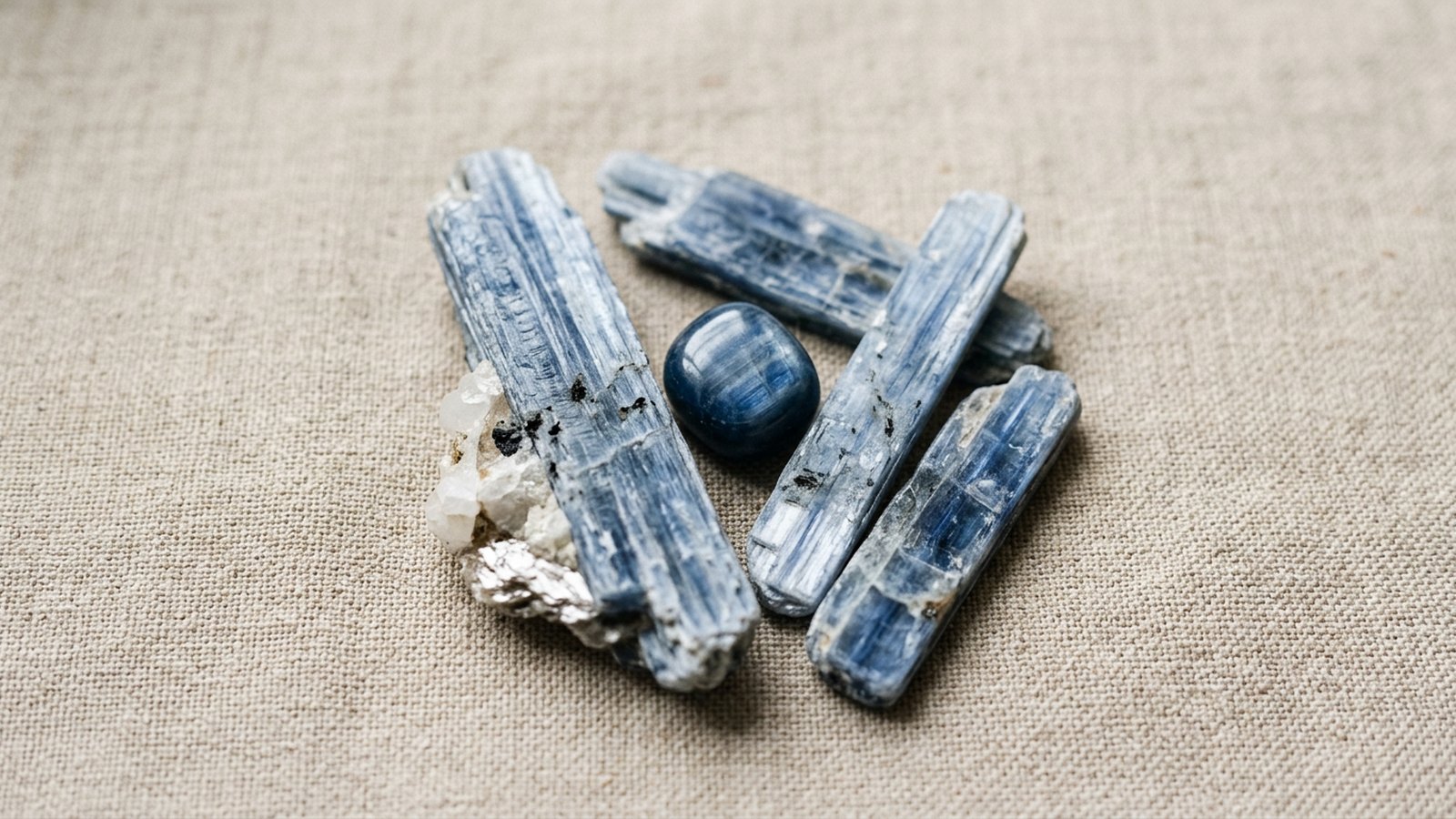
Kyanite means "deep blue", straight from the Greek kyanos, the same root that gives us the colour cyan. In crystal tradition it is the stone of attunement and clear speech, tied to the throat chakra and to saying the true thing rather than the easy one. Mineralogically it is an aluminium silicate that grows only under real pressure, deep inside mountains being built.
I have handled a lot of kyanite, and it never quite behaves like other stones. The blades are flat, striated along their length, and the blue is streaky rather than even, pooling in the centre of a blade and fading to almost white at the edges. Run a thumbnail down one and it feels faintly satiny. Press the same blade sideways and it feels like glass. That contradiction is not poetic licence. It is a measurable property, and it turns out to be the key to almost everything else about this stone: how to buy it, how to wear it, whether to put it in water, and why the crystal world tells one particular story about it that nobody can actually verify.
What Kyanite Is, and Where the Name Comes From
Kyanite is aluminium silicate, Al2SiO5, crystallising in the triclinic system as long bladed crystals that often splay out in fans or lie stacked like a handful of dropped rulers. The lustre on a fresh cleavage face is pearly, almost silky. Colour runs from pale sky to a saturated near-sapphire, with white, grey, green, black and, rarely, orange also occurring.
Abraham Gottlob Werner named it in 1789 from kyanos. It carries a second, older name too: disthene, from the Greek for "two strengths". Eighteenth century mineralogists had already noticed what your thumbnail notices. They just gave it a better name than we did.
Kyanite Meaning in Crystal Tradition
The traditional reading of kyanite is attunement: the sense of separate parts of a person coming back into line with each other. Most sources describe it as a stone that opens pathways rather than one that supplies energy, and I think that framing is right. Working with kyanite does not feel like being switched on. It feels like something that was jammed has come loose.
Its strongest association is with the throat chakra and with honest speech. Not louder speech, and not more confident speech, but accurate speech: the difference between what you meant and what you actually said out loud. That is why it turns up in so many people's kits alongside lapis lazuli and sodalite, the other two blues that get handed to anyone learning to speak plainly. If you want the wider map of which stone sits where, our chakra crystals guide lays out all seven.
The second traditional claim is that kyanite aligns the chakras quickly and does not hold onto anything heavy. I will come back to that one, because it is the most repeated sentence on the internet about this stone and it deserves a proper look rather than a nod.
As always here: these are traditions and intuitions carried forward by people who work with stones. They are not medicine, and no stone should stand in for a doctor, a therapist, or a difficult conversation you already know you need to have.
Reasons to Work With Kyanite
Kyanite is for the conversation you have been rehearsing for a week. The performance review, the boundary with a relative, the thing you have drafted five times and sent none of. Kyanite is traditionally carried for exactly this: not for courage, but for precision under pressure.
Kyanite is for creative work that has stalled between the idea and the page. The blockage most people describe is not a lack of ideas but a lack of route out of the head. Attunement stones are traditionally used for that gap, which is also why kyanite shows up in our guide to crystals for focus territory without ever being the loudest name on the list.
Kyanite is for people who take on other people's moods. The tradition holds that it does not accumulate what passes through it, which makes it the stone of choice for anyone who ends a working day feeling like a sponge.
Kyanite is for meditation that keeps sliding off. It has a long association with dream recall and with quieting the running commentary, and it pairs naturally with the settling practices in meditating with crystals.
The Colours, and Which One You Actually Have
Kyanite is one of the few stones where the colour genuinely changes the traditional use, because each shade got attached to a different chakra.
Blue is by far the most common and the one meant when a shop says simply "kyanite": throat chakra, communication, truthfulness. Green is heart chakra in the tradition, read as growth and the repair of things worth repairing, in the same family of intent as malachite. Black kyanite comes as splayed fans rather than single blades, is used for grounding and boundary work, and sits comfortably beside black tourmaline and hematite in a protection setup. White and grey are read as crown chakra clarity, yellow as solar plexus.
Orange is the rarest, and unlike most "rare" claims in this trade that one has a documented cause. Orange kyanite comes essentially from a single Tanzanian source, and its colour comes from small amounts of manganese, Mn3+, sitting in the crystal structure. There is very little of it, it is small, and it is priced accordingly. If you are offered large cheap orange kyanite, be sceptical.
Kyanite Correspondences
- Chakras: throat and third eye (blue), heart (green), root (black), crown (white)
- Zodiac: Taurus, Aries and Libra in modern practice, with the honest caveat below
- Element: Air
- Numerical vibration: 4
- Affirmation: I say the true thing, in the fewest words it needs.
On zodiac: the lists disagree with each other. One of the largest crystal encyclopedias states flatly that kyanite has no zodiac association at all, while two of the next-ranked pages assign it to Taurus, Aries, Libra and sometimes Pisces. Kyanite is not a traditional birthstone and has no anniversary status. The Taurus link is the most defensible one, since Taurus rules the throat, and the rest is modern attribution. I would rather tell you that than pick a sign and sound certain.
The Geology: One Formula, Three Different Minerals
Here is the fact I most wish crystal pages would tell, because it makes kyanite far more interesting than "forms under high pressure".
Al2SiO5 does not describe one mineral. It describes three. Kyanite, andalusite and sillimanite are chemically identical and physically different, because the same atoms pack differently depending on the pressure and temperature they crystallise under. Andalusite forms at low pressure, sillimanite at high temperature, and kyanite is the high-pressure form. All three are equally stable at a single triple point near 4.2 kilobars and about 530 degrees Celsius, and which one you get depends on which side of that point the rock sat.
So a kyanite blade is a receipt. It says: this rock was buried deep, roughly fifteen kilometres down or more, and squeezed. Geologists use exactly that logic professionally, which is why kyanite is a classic index mineral, used since George Barrow's work on the Scottish Highlands to map metamorphic zones and read the pressure history of a mountain range. The kyanite in Manhattan schist under New York City records the collision that built Pangaea.
It has an industrial life too. Heated past about 1100 degrees Celsius, kyanite converts to mullite and silica, and mullitised kyanite goes into refractory bricks, kiln furniture, spark plugs and abrasives. The stone sold to you for calm speech is also what lines a furnace.
Commercial specimens today come mainly from Brazil, Nepal, India, Kenya, Tanzania, Myanmar, Switzerland and the Appalachians of the United States. Nepalese material has the reputation for the best deep blue blades.
Two Hardnesses, and the Pin Test
This is kyanite's signature and it is genuinely unusual: the same crystal has two different hardnesses depending on the direction you test it. Along the length of a blade it is about 4.5 to 5.5 on the Mohs scale. Across the blade it is about 7. A steel needle will scratch a kyanite crystal parallel to its long axis and will not touch it perpendicular to that axis.
You can do that yourself, on an inconspicuous edge, and it is one of the cleaner identification tests in the hobby. Almost nothing else fails and passes the same needle depending on which way you drag it. If you want the broader toolkit, we cover it in how to tell if a crystal is real.
Two practical consequences follow. First, kyanite has perfect cleavage running parallel to the blade, so it splits along its length cleanly and unhelpfully. Dropped kyanite does not chip, it splits. Second, this is why faceted kyanite is scarce and expensive to cut: the cutter is fighting a stone that is soft one way, hard the other, and eager to part. A well-cut faceted kyanite is a genuine display of skill, not a markup.
When buying, look for colour that streaks and pools within a single blade. Kyanite's uneven, zoned blue is hard to fake, and suspiciously uniform colour on cheap material usually means dye.
Water, Care, and That Cleansing Claim
Can kyanite get wet? Chemically, yes: it is a silicate, it does not dissolve, and a brief rinse will not harm a polished piece. Structurally, be careful. That perfect cleavage plus a hardness of only about 4.5 along the blade means water works into the partings of raw blades, and repeated soaking lifts flakes off a specimen that arrived intact. Iron-bearing inclusions and attached matrix can also stain and rust. So: quick rinse and dry for tumbled pieces, no soaking, and keep raw fans dry. Our crystals and water safety guide covers the same logic for the rest of your set.
Store kyanite flat and separately. It will scratch and split against harder stones in a pouch, and it is one of the stones I would not put in a tumbler with quartz.
Now the claim. You will read, on page after page, that kyanite is one of only two minerals on earth that never accumulates negative energy and therefore never needs cleansing. I traced that sentence across the top results for this stone and it is close to verbatim in several of them, which tells you it has one origin and many copies rather than many independent observations. It is not something anyone can test, so I file it where it belongs: as tradition, not fact.
What I will say from practice is that kyanite is a low-maintenance stone to keep, and if the tradition helps you leave it alone, no harm done. If you would rather cleanse it anyway, use sound, breath, or a short smoke rather than water or salt. Our cleansing crystals and how to activate crystals guides both cover dry methods that suit a soft, splitting stone.
What Pairs Well With Kyanite
Pairing questions came up twice in the questions people actually ask about this stone, so here are the combinations I think earn their place.
Kyanite and clear quartz is the workhorse. Quartz is the amplifier of the tradition, kyanite the aligner, and the pair is the standard opener for a session where you want things to settle before anything else happens.
Kyanite and lapis lazuli doubles down on the throat. Lapis is the older, heavier stone of truth-telling; kyanite is the lighter one that helps the words arrive in order. Good before a difficult conversation.
Kyanite and blue lace agate is gentler again, and my preference when the problem is not finding the words but staying calm enough to use them.
Kyanite and amethyst is the meditation pair, traditionally used for dream work and quieting mental noise.
One combination I would not rush into is kyanite with moldavite. Both are described as fast, and doubling intensity is rarely the problem people actually have. On what does and does not belong together, see what crystals should not be together.
How to Use Kyanite
Carry a small blade in a pocket on days that involve saying something hard, and hold it for a moment before you speak. In meditation, lie down with a blade at the base of the throat, pointing up along the body, and give it ten minutes without asking it for anything. For sleep and dream recall, place it on the bedside table rather than under the pillow, where it will split. For jewellery, favour pendants and earrings over rings and bracelets: hands take knocks, and kyanite does not forgive knocks. Nothing here needs to be elaborate, and carrying and wearing stones covers the basics.
Frequently Asked Questions
What does kyanite do spiritually? In crystal tradition, kyanite is a stone of attunement: it is used to bring the chakras and the mind back into alignment rather than to add energy, and blue kyanite specifically supports honest, precise speech.
Is kyanite a stone or a crystal? Both, properly speaking. It is a naturally occurring mineral that forms true crystals, in bladed form, in the triclinic system. "Stone" and "crystal" are used interchangeably in this field.
Who can wear blue kyanite? Anyone. There is no traditional restriction on kyanite. Practically, choose pendants and earrings over rings, since a blade splits along its length if it takes a knock.
What is the rarest colour of kyanite? Orange, coloured by manganese and effectively confined to one Tanzanian source. Green and black are uncommon but obtainable; blue is everywhere.
Can kyanite get wet? Briefly, yes, for polished pieces. It does not dissolve, but its perfect cleavage means soaking works water into the splits and lifts flakes off raw blades, so rinse and dry rather than soak.
What is the most powerful crystal combination? There is no ranked answer to this, whatever the lists say. The useful question is which pair suits your intention, and for kyanite that is usually clear quartz for alignment or lapis lazuli for speaking up.
A Last Word
Kyanite is the stone I reach for when the problem is not effort but alignment: when I know what I think and cannot get it out cleanly. It asks very little maintenance and gives back a kind of orderliness. Handle it gently, keep it dry, keep it flat, and let its two hardnesses remind you of the thing it is actually good at, which is being soft in one direction and unyielding in the other, and knowing which is which.