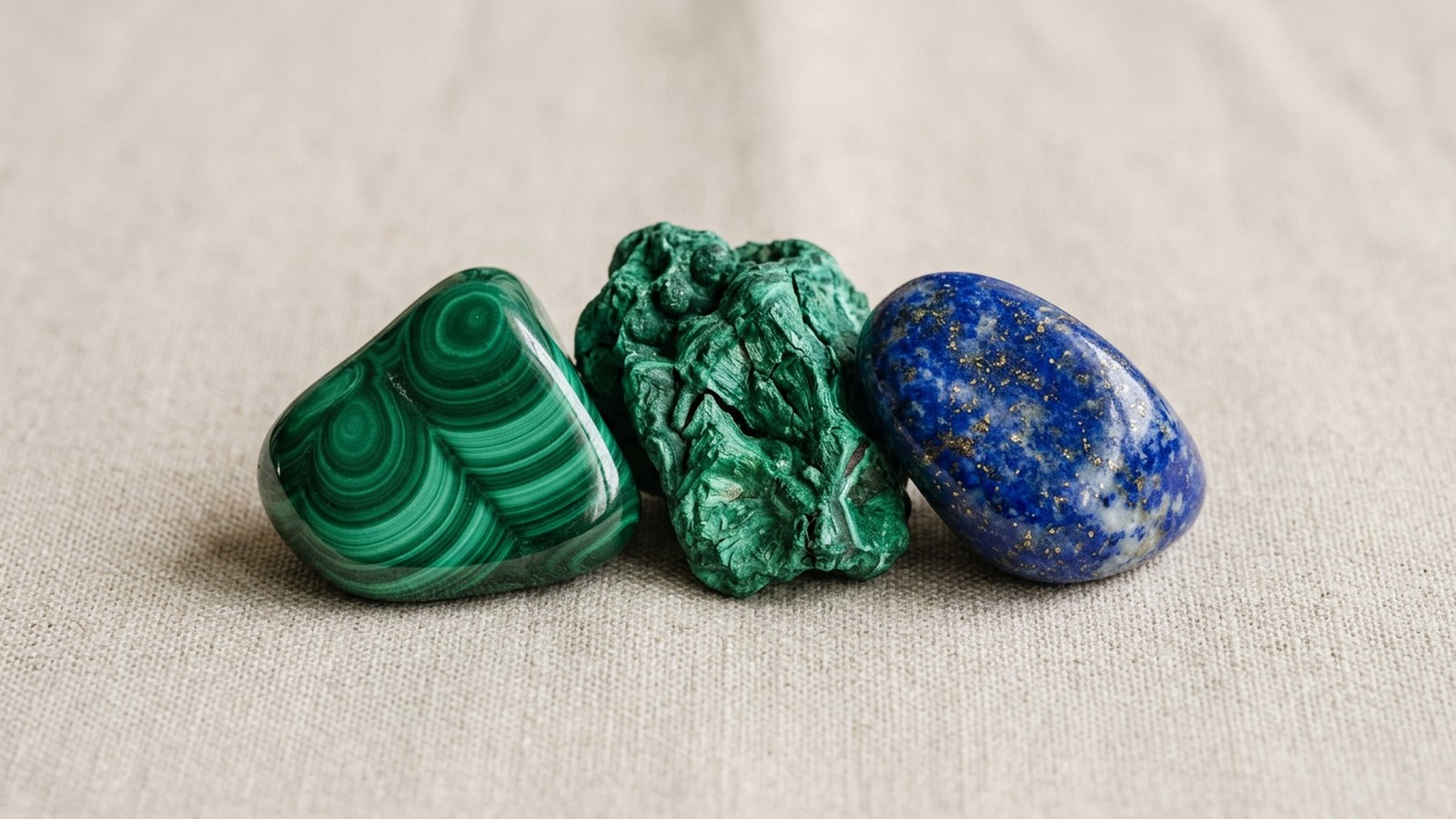
I keep a small dish on my desk with two stones in it, a lapis lazuli tumble the colour of a late evening sky and a palm-sized slice of malachite with rings like the inside of a tree. I put them together years ago for a simple reason: I liked looking at them side by side. Only later did I learn that people have been setting these two colours next to each other for about five thousand years, in tombs, on painted walls and in the columns of a Russian cathedral.
In this guide I explain what each stone really is and why they never actually grow together. I also cover the long history of the blue and green pairing, what crystal tradition says the duo is for, three simple ways to use it, and the care rules that matter more here than with most pairs, because both stones are soft and neither one likes water.
Lapis lazuli and malachite: the short answer
Lapis lazuli is a deep blue rock made mostly of the mineral lazurite, with gold flecks of pyrite and white streaks of calcite. Malachite is a green copper carbonate, banded in light and dark rings. In crystal tradition, lapis is linked to truth, insight and clear speech at the throat chakra and third eye, and malachite to change, emotional honesty and protection at the heart chakra. Together they are said to help you say what your heart already knows. Physically they get along well as long as you remember two things: lapis is harder than malachite and will scratch it, and neither should be soaked in water.
Two stones from two different worlds
Lapis lazuli is technically a rock rather than a single mineral. It forms when limestone or marble is cooked by nearby magma, a process called contact metamorphism, and the blue comes from lazurite, a sulphur-bearing member of the sodalite group. The classic source is the Sar-e-Sang valley in Badakhshan, northeastern Afghanistan, worked for more than six thousand years. Chile and the Lake Baikal region of Russia produce paler material. Lapis sits around 5 to 5.5 on the Mohs scale and feels light in the hand for its size.
Malachite forms in a completely different setting: the oxidised upper zone of copper deposits, where water carrying dissolved copper seeps through rock and leaves green crusts, layer after layer. That slow layering is what produces the bands and the rounded, bubbly shapes collectors call botryoidal. Most malachite on the market today comes from the Katanga copper belt of the Democratic Republic of Congo; the famous nineteenth century material came from the Ural Mountains. It is soft (3.5 to 4) and surprisingly heavy, with a density close to four.
Because one stone comes from cooked marble and the other from weathered copper ore, you will not find them growing in the same specimen. This matters when you shop. A natural stone that is blue and green in one piece is almost always azurite-malachite: azurite is malachite's blue copper sibling, and it slowly turns into malachite over geological time. Some sellers describe it as "lapis and malachite", which is understandable but inaccurate. A cabochon that shows clean lapis next to clean malachite is an inlay or a composite, made by a craftsman, which is lovely in its own right as long as it is sold as such.
The blue and green palette of history
What I find moving about this pair is how often people chose it long before anyone wrote about crystal energy. In ancient Egypt, ground malachite made a green eye paint worn by both men and women, and lapis carried across more than two thousand kilometres from Afghanistan was carved into scarabs and inlaid into royal jewellery. The eye outlines and eyebrows on Tutankhamun's gold mask are lapis.
Both stones also became pigments. Lapis ground and purified gave ultramarine, whose name means "from beyond the sea" and which was for centuries more expensive than gold. Some of its earliest known uses are in the seventh century cave paintings of Bamiyan, in Afghanistan. Malachite gave a stable green used in Chinese painting, where it is still called mountain green, and on European panels.
The most spectacular meeting of the two is in Saint Petersburg. The iconostasis of Saint Isaac's Cathedral, finished in 1858, is framed by eight great columns of malachite and two smaller columns of lapis lazuli. A few streets away, the Malachite Room of the Winter Palace, rebuilt after the fire of 1837, holds about two tonnes of Ural malachite. Standing in front of those columns, you understand why the combination keeps returning: deep blue and living green read as sky and earth, and they look calm together.
A last note for anyone searching this pair and landing on a cartoon: in the animated series Steven Universe, Malachite is a character formed by fusing Lapis Lazuli and Jasper. The name is a nod to the stones, and the show does not describe their properties.
Why crystal practitioners pair them
Here I move into tradition and personal experience, which is how I would ask you to read this section. Lapis has long been called a stone of wisdom and truth. Many people use it when they need to think clearly or find words, which is why it sits in my guide to crystals for communication and among the stones for intuition. Malachite is described as a stone of transformation, one that brings feelings to the surface and is traditionally carried for protection, especially by travellers and children in older European folklore.
Put together, the pair is usually read as a line running from heart to throat. Malachite is said to bring up what you actually feel, and lapis is said to help you express it with some composure. In my own practice I reach for the two together before conversations I have been avoiding: telling a friend something difficult, asking for a change at work, ending something gently. The jewellery maker who wrote about her lapis and malachite collection framed it as friendship and abundance, which is another fair reading of the same idea, since honest speech and an open heart are what friendships are built on.
Three ways to work with lapis lazuli and malachite
- Heart and throat meditation (10 minutes). Lie down and place the malachite on your breastbone and the lapis in the hollow of your throat or, if that feels too close, on your collarbone. Breathe slowly and ask yourself one question: what do I need to say, and to whom? Write down the first sentence that comes. My guide to meditating with crystals covers posture and timing if you are new to this.
- A pocket pair for a hard conversation. Carry one small tumble of each, in separate pockets or separate cloth pouches, on the day you need to speak. Hold the malachite before you go in and the lapis while you talk. The stones work here as a physical reminder of the intention you set.
- A desk or journal pairing. Keep lapis near where you study or write and malachite near where you plan changes. Some people place them on either side of a notebook used only for honest journaling. Set the intention once, as described in programming an intention, and leave them be.
What the pair is not for, and who might wait
I would not choose this duo for sleep or for winding down at night. Malachite in particular has a reputation for stirring up emotion, and lying awake with whatever it brought up is not restful. For evenings I prefer one of the softer stones in my guide to calming crystals.
If you are going through a raw period of grief or anxiety, you may also find malachite too intense for now and do better with lapis alone, or with a gentler heart stone such as rose quartz. And as always, no stone replaces a doctor, a therapist or a hard conversation that needs a mediator. The pair is a support for your intention, and the conversation itself remains yours to have.
Hardness, bracelets and storage
This is the practical rule most sellers skip. Lapis, at 5 to 5.5, is harder than malachite at 3.5 to 4, so every time they rub together the malachite loses a little of its polish. On a bracelet with alternating beads, the malachite beads will turn dull and scuffed long before the lapis shows any wear. Pyrite flecks inside lapis are harder still, around 6, which adds to the abrasion.
If you love a mixed bracelet, accept that it is a piece you wear for occasions, and take it off for washing hands, cooking, gym and sleep. For everyday wear, a pendant of one stone and a ring or bracelet of the other keeps them from grinding. At home, store them in separate pouches or in a divided box, as I describe in how to store crystals. Some people choose the hand by tradition, and my guide on which hand to wear a crystal bracelet explains the receptive and giving sides.
Water, cleansing and safety
People often ask why malachite cannot go in water. Strictly speaking, a quick rinse will not dissolve it, but repeated soaking dulls the polish, any acidity (tap water with additives, lemon, vinegar, salt water) slowly attacks the carbonate, and polished malachite is often stabilised with wax or resin that does not like long baths. Lapis has the same weak points: its calcite reacts with acids, it is porous, and much commercial lapis is waxed or dyed, so water and salt are both bad ideas. The full list is in my crystals and water safety guide.
Malachite also contains copper, and that is where the safety question comes in. Polished, sealed malachite is safe to handle and wear. Dust from raw or freshly cut malachite is toxic if breathed in or swallowed, so do not sand, carve or cut it at home without proper protection, keep raw pieces away from small children and pets who might mouth them, and never put malachite directly in drinking water to make an elixir.
To cleanse the pair, I use smoke, sound or a night on a windowsill under the moon, and I keep both out of strong daylight for long periods. My cleansing guide lists the dry methods in detail.
Fakes on both sides, and a weight test
Both stones are heavily imitated. For lapis, the common substitutes are dyed jasper (sometimes sold as "Swiss lapis"), dyed howlite, sodalite with its lighter blue and lack of gold flecks, and reconstituted powder in resin. Rub a cotton swab with a little acetone on a hidden spot: if it comes away blue, the stone is dyed. My comparison of sodalite and lapis lazuli goes through the visual differences.
For malachite, watch for plastic or resin with printed bands, and for "reconstituted malachite", which is crushed malachite bound in resin. Real malachite feels cold and noticeably heavy: a piece the same size as a lapis tumble should weigh roughly a third more. The bands in natural malachite curve and bend around rounded growths, while printed bands repeat too neatly. If someone offers you a single natural stone in blue and green as lapis and malachite, ask whether it is azurite-malachite. My guide to telling real crystals from fakes covers other simple checks, and chrysocolla vs malachite helps with another common mix-up.
The questions about who should not wear them
Several searches about this pair ask who should not wear malachite, or whether women should avoid lapis. Most of these warnings come from Vedic astrology, where lapis (rajavarta) is assigned to a planet and then recommended or discouraged according to a person's birth chart. These rules vary between astrologers, and nothing in gemmology supports a warning based on gender. The only physical cautions I would give are the ones above: be careful with malachite dust, and do not wear these soft stones for rough work. For a wider view of which stones people prefer to keep apart, see what crystals should not be together.
A last word
If you are drawn to these two, I would start small: one tumble of each on a desk, kept from rubbing, used before one conversation that matters to you. Lapis already has a well-loved partner in turquoise, and malachite works with pyrite for people focused on work and money, but this blue and green pair is the one I come back to when I need to be honest without being harsh. I hope it gives you a similar quiet nudge.